Why Most Automation Projects Fail Before They Start (And How a Readiness Audit Fixes That)
The majority of automation projects fail, not because of bad technology, but because of avoidable mistakes made before a single line of code is written.

Most businesses that try automation and give up aren't dealing with a technology problem. They're dealing with a planning problem that started long before anyone opened a laptop.
There's a pattern that plays out in businesses across almost every industry. Someone in leadership decides it's time to automate. The team picks a tool, or hires someone to build something, and six months later the project is over budget, under-delivered, and quietly shelved. The business goes back to doing things the manual way and writes off automation as "not right for us yet."
It happens more often than most people admit. And in almost every case, the problem wasn't the technology. The technology was fine. The problem was everything that came before the technology was chosen.
This post breaks down the most common reasons automation projects fail, and how a structured readiness audit addresses each one before the damage is done.
The Most Expensive Mistake: Starting Without Clarity
The single most common reason automation projects fail is that they begin without a clear understanding of the problem being solved. A business identifies a pain point, let's say it takes too long to process new customer orders, and immediately starts looking at tools. They find something that looks promising, buy a licence, and start configuring it.
Three months later, they realised the delay in order processing wasn't caused by a lack of automation. It was caused by an approval bottleneck that sits with one person. No tool could have fixed that.
The problem was never fully understood before the solution was chosen. This is where the money goes.
Reason One: No Clear Ownership
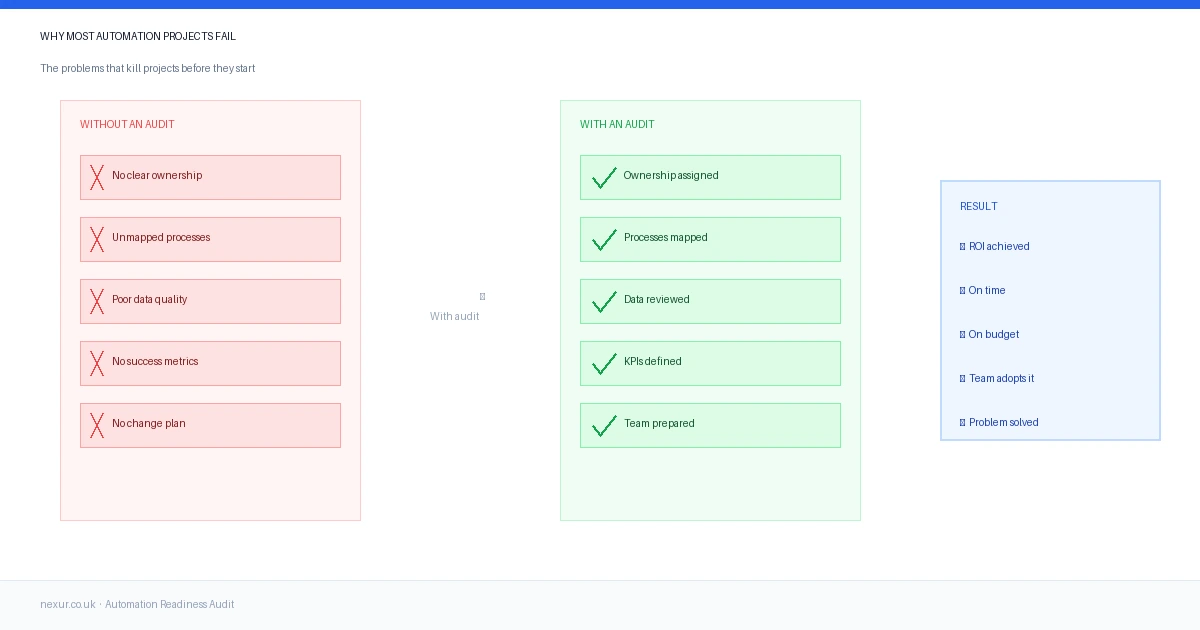
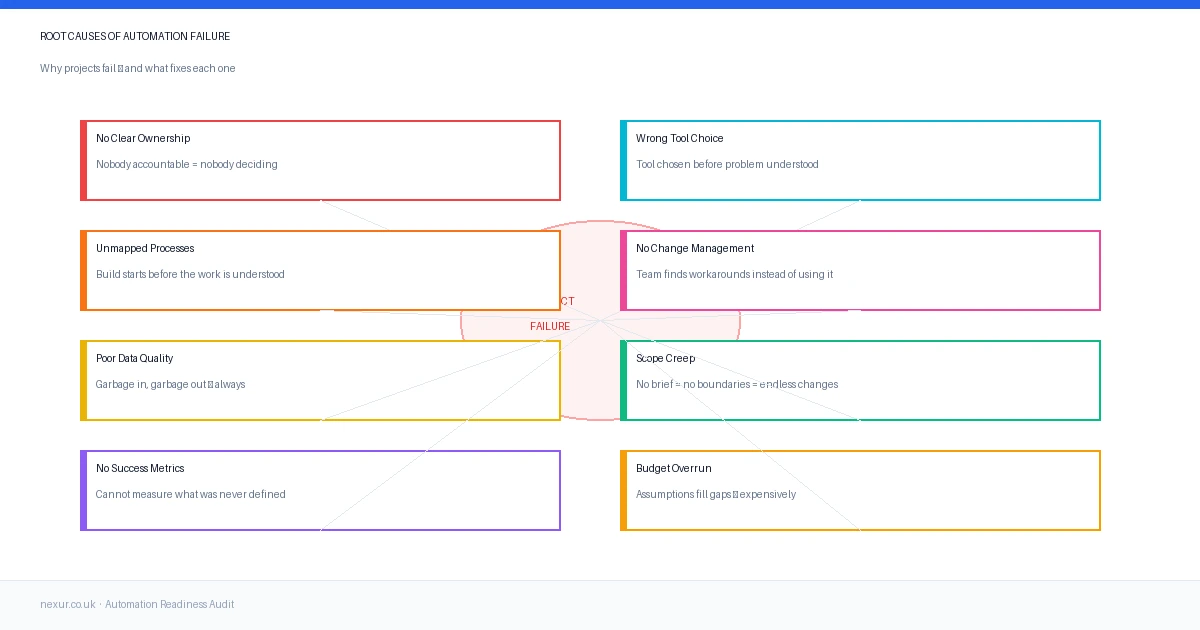
Automation projects without a named owner almost always drift. Decisions get deferred. Nobody has authority to make the call. When something goes wrong, and something always goes wrong, there's no clear person responsible for fixing it.
A readiness audit surfaces this immediately. One of the first things it establishes is who owns each process that's being considered for automation. If ownership is unclear or shared between multiple people without accountability, that gets flagged before the project starts.
Reason Two: Processes Are Not Mapped Before the Build
You cannot automate a process you haven't documented. This sounds obvious but is violated constantly. Businesses often have a general idea of how something works but have never written it down step by step. When a developer asks for the process map, someone creates one from memory, and it's missing half the edge cases, exceptions, and handoffs that make the real process what it actually is.
The build is then designed around the simplified version. When it goes live, it breaks immediately because real life is messier than the version on paper.
Mapping processes properly is a core part of what happens in an automation readiness audit. Before any build is scoped, the actual process is understood, including the messy bits.
Reason Three: Data Quality Is Ignored
Automation needs clean, consistent data to work. If your CRM has duplicate records, missing fields, and inconsistent formatting, any automation built on top of it will produce inconsistent results. The automation isn't broken; the data underneath it is.
This is one of the most underestimated problems in automation projects. Everyone assumes the data is fine because it's been sitting in the system for years. But systems accumulate mess. Data entered by different people in different formats, fields used for the wrong purposes, and records that were never cleaned after a team member left.
A readiness audit looks at data quality as a prerequisite, not an afterthought. If the data needs work before automation can be reliable, that comes out in the audit findings rather than mid-build.
Reason Four: No Success Metrics Were Defined
If you don't know what success looks like before you start, you can't know whether you've achieved it when you finish. This sounds basic. It gets skipped constantly.
Automation projects need clear, measurable outcomes defined upfront. Not "we want things to be faster" but "we want order processing time to drop from 48 hours to 4 hours, and invoice errors to reduce from 15 per month to zero." When the metrics are specific, the build can be designed to deliver them. When the project ends, you can evaluate whether it worked.
Without this, projects get extended, rescoped, and eventually abandoned, because nobody can agree whether they're done.
Reason Five: Change Management Was an Afterthought
Technology projects fail at the human layer more often than the technical one. You can build a perfect automation system and still see it fail because the team doesn't trust it, doesn't understand it, or quietly finds workarounds to avoid using it.
People resist change, especially when they weren't involved in the decision to change. A readiness audit includes your team from the beginning, their evaluations, their process knowledge, their concerns. By the time the build starts, they've been part of the process. That changes how they engage with the output.

Featured
Don’t Let Your Automation Project Fail Before It Begins
Most automation failures are not technical, they’re planning failures. Identify broken processes, unclear ownership, poor data quality, and missing success metrics before you invest in building anything.
De-Risk Your Automation ProjectWhat a Readiness Audit Actually Prevents
When you look at the list above, a pattern emerges. Every single failure reason is a planning failure, not a technology failure. Every one of them is identifiable and addressable before a line of code is written.
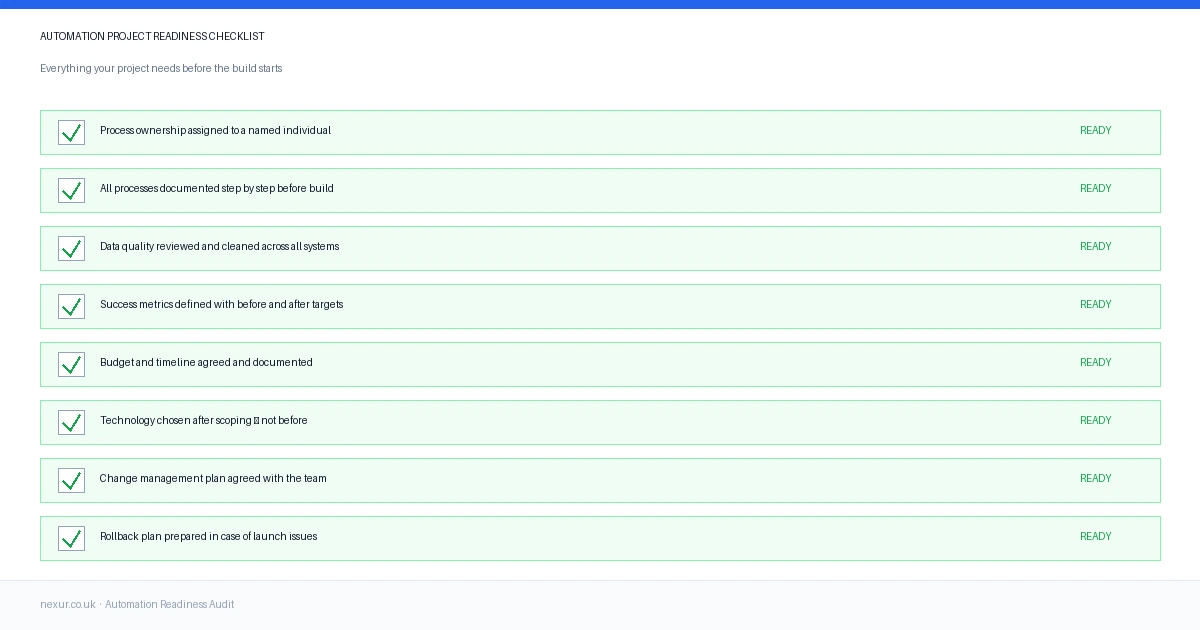
That's exactly what a readiness audit is designed to do. It forces the clarity that most projects skip. It maps the actual processes, not the assumed ones. It checks the data, establishes ownership, defines metrics, and surfaces the team's concerns before they become blockers.
The businesses that see consistent ROI from automation are not the ones with the biggest budgets or the most sophisticated tools. They're the ones that do the groundwork first.
The Cost of Skipping This Step
A failed automation project doesn't just waste the build budget. It wastes the time your team spent on it, erodes confidence in future technology investments, and leaves the original problem unsolved, meaning the manual process cost continues accumulating on top of the project cost.
For most small and growing businesses, a failed automation project sets the entire programme back by one to two years. The financial cost is real. The opportunity cost is larger.
The irony is that a structured readiness audit costs a fraction of what a failed build costs, and Nexur's is currently free for selected businesses through the pilot programme.
Don't start a build without knowing it's going to work. Nexur's Automation Readiness Audit identifies every risk before it becomes a cost. Apply for the free audit →
Keywords