Case Walkthrough: How an Automation Audit Reshaped a Service Business' Operations
A step-by-step look at what happened when a growing service business ran a Nexur Automation Readiness Audit, from the first conversation to 90 days after delivery.

When the managing director of a professional services firm first got in touch, she was clear about one thing: she knew something was wrong but couldn't put her finger on what.
The business was doing well by most measures. Revenue was growing. The team was capable. Clients were happy. But underneath the surface, things were fraying. Month-end was consistently painful. New client onboarding took weeks longer than it should. A significant share of leads were going cold because nobody followed up in time. And the MD was spending hours every week chasing status updates that should have been available at a glance.
She wasn't sure whether the answer was automation, a new system, a new hire, or just a better way of working. She didn't know where to start. That's why she came to Nexur.
Before: What the Business Actually Looked Like
Before the audit began, we asked the MD to describe the business as honestly as she could. What came out was a picture that will be familiar to many growing businesses.
The firm had three main systems: a CRM for client management, an accounting package for invoicing and payments, and a project management tool for tracking work. None of them talked to each other. Information entered in one system had to be manually re-entered in another. This happened multiple times a day, across multiple people.
The firm also had a collection of spreadsheets, six by the time the audit was complete, that had been built over the years to fill gaps the main systems couldn't handle. Some were maintained by one person. Nobody else fully understood them. If that person left, several key processes would break.
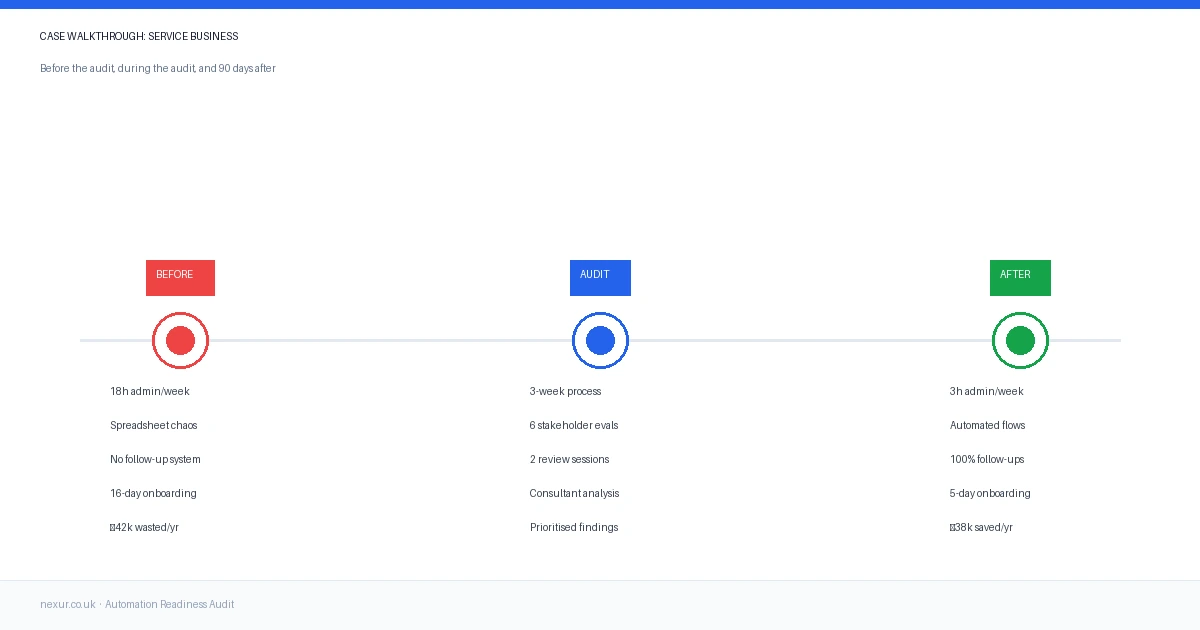
Client onboarding involved 14 manual steps across three people. There was no checklist. New starters learned the process by sitting with a colleague. The process varied slightly depending on who was doing it.
Follow-ups after proposals were not systematically tracked. The MD estimated that roughly a third of proposals sent in the previous quarter had received no follow-up because the team was too busy.
The Audit: Three Weeks of Structured Discovery
The Growth package audit ran over three weeks. Six stakeholders completed the online evaluations, the MD, the operations lead, two senior client managers, the finance manager, and a recently joined team member who was able to provide a useful outside perspective.
The evaluations flagged several areas for deeper review. Two consultant-led process review sessions were then scheduled, one focused on operations and client delivery, one on finance and reporting.
These sessions were described by the operations lead as the most useful conversations the leadership team had ever had about how the business actually worked. Not how it was supposed to work. How it actually worked, including the workarounds, the exceptions, and the things that had never been properly decided.
The Findings: What the Audit Surfaced
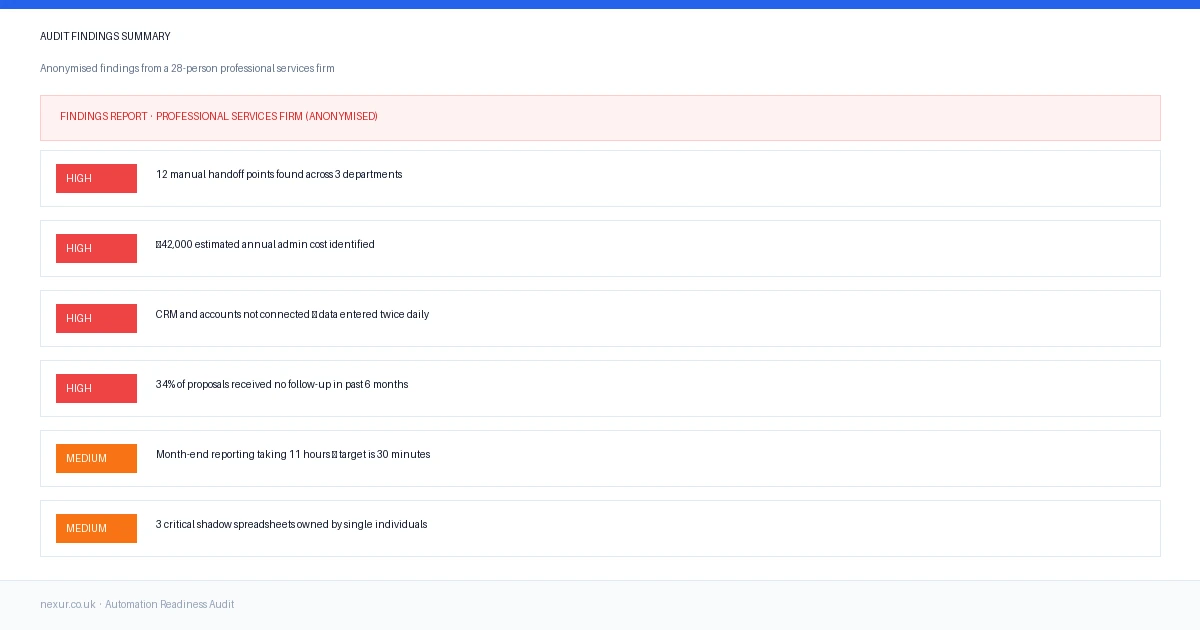
The audit surfaced twelve distinct issues. Six were classified as high priority. Here are the most significant:
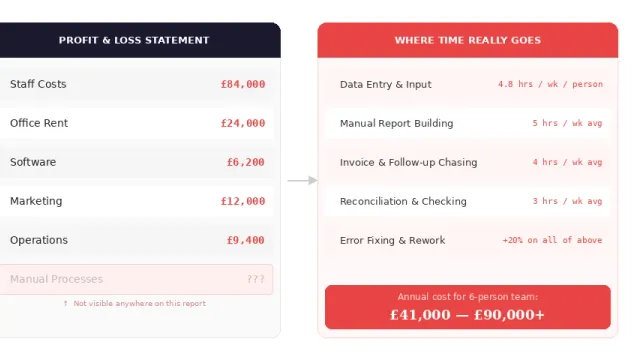
Manual handoffs between systems. The CRM, accounting, and project management tool were not connected. Data was being re-entered in at least three places. The estimated annual cost of this single issue was £18,000 in staff time, before errors were factored in.
No automated follow-up process. The audit confirmed the MD's concern. 34% of proposals in the previous six months had received no follow-up. There was no system to ensure it happened. This was framed not as a people problem but as a process problem. the business had no mechanism to prompt or track follow-ups.
Month-end reporting. Generating the monthly management report was taking the finance manager eleven hours. This was a combination of pulling data from multiple places, reformatting it, and resolving discrepancies between systems. The target, with proper integration and automation, was under thirty minutes.
Shadow spreadsheets. Three spreadsheets were identified as critical to operations but owned by single individuals, undocumented, and fragile. If any of those people left or was unavailable, the processes they supported would break.
Client onboarding. The 14-step manual onboarding process had no standard documentation. The average onboarding time was sixteen days. The benchmark for the industry was four to five days.
The Recommendations: Prioritised and Practical
The findings report didn't just list problems. It provided a prioritised action plan with three tiers: quick wins, medium-term initiatives, and longer-term strategic changes.
The quick wins were things the business could address immediately, without building anything new. Documenting the onboarding process. Assigning ownership to the shadow spreadsheets. Setting up a simple automated reminder for proposal follow-ups using the CRM tools the business already owned.
The medium-term initiatives included integrating the CRM with the accounting system and automating the data flows between them, building an automated reporting dashboard, and replacing the manual onboarding checklist with a structured digital workflow.
The longer-term recommendations included moving to a unified platform that reduced the number of systems the business was managing.
After: 90 Days Later
The MD implemented the quick wins within two weeks of receiving the report. The medium-term initiatives were scoped and built over the following ten weeks, using the audit findings as the brief for the development work.
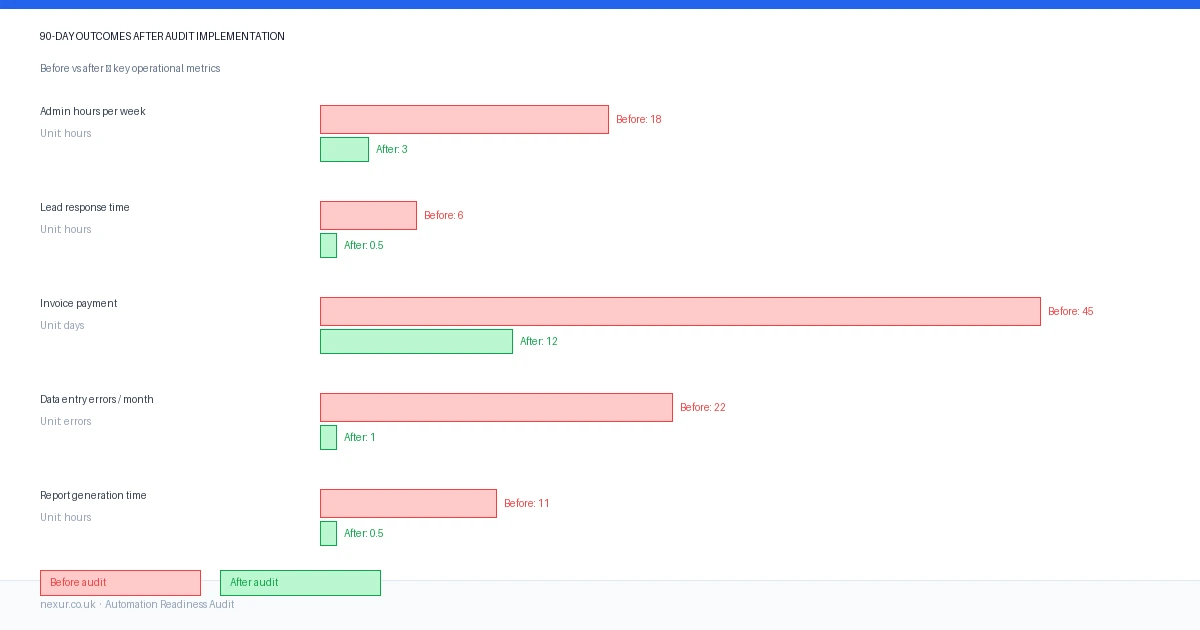
Ninety days after the audit was complete, the outcomes were clear. Admin time across the team had dropped from approximately eighteen hours per week to around three. Lead follow-up rate had reached 100% for the first time. Month-end reporting was taking forty minutes rather than eleven hours. Client onboarding was running at five to six days, down from sixteen.
The MD's estimate of total annual savings from the changes implemented was £38,000, with the full programme cost well below that.
What Made the Difference
When the MD was asked what had made the biggest difference, she didn't say the technology. She said having an external view of the business for the first time.
"We were too close to it," she said. "We knew things weren't working but we'd normalised it. Having someone come in, look at it properly, and tell us clearly what to fix and in what order that was the thing that unlocked everything."
That's the purpose of an automation readiness audit. Not to sell a technology solution. To give growing businesses the clarity they need to make good decisions.

Featured
Turn Operational Chaos Into a 90-Day Transformation Plan
If your systems don’t talk to each other, follow-ups slip through the cracks, and reporting takes hours instead of minutes, an automation audit gives you a clear, prioritized roadmap to fix it fast—just like this case study.
Start Your Audit JourneyKeywords