The Hidden Cost of Manual Processes
Most business owners know manual processes are inefficient. Very few have ever sat down and worked out the actual number. The figure is almost always worse than expected.

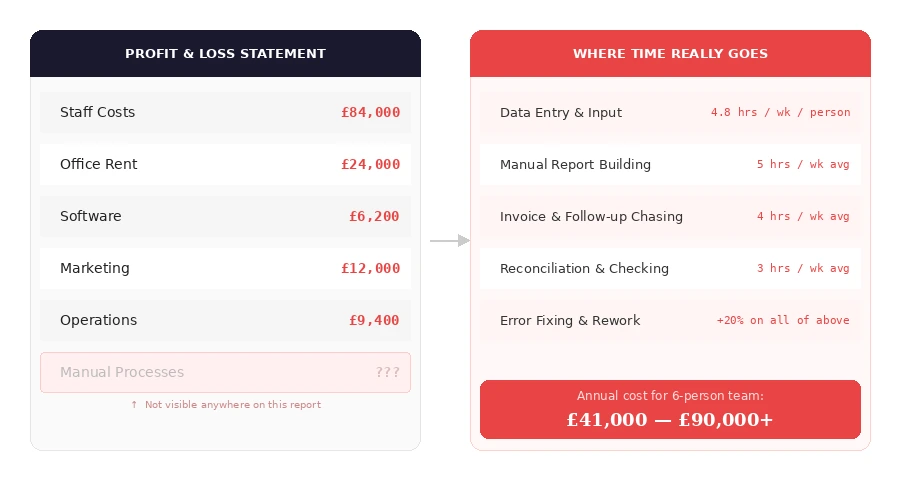
Every manual process has a measurable cost, most owners have never calculated it
Ask most small business owners what their biggest expense is, and they'll say staff, rent, or software subscriptions. Very few will say "the 14 hours a week my team spends on tasks that a well-configured system could handle in seconds." But for most businesses under 50 people, that's exactly where the money is going.
Manual processes are the silent drain on business performance. Unlike a bad hire or an expensive supplier, they don't show up on a P&L. They don't trigger an alert. They just quietly consume time, introduce errors, and limit how fast you can grow, year after year.
This post gives you a framework for calculating what manual processes are actually costing your business, and what to do once you know the number.
Why do manual process costs stay hidden?
There are three reasons most business owners underestimate the cost of manual processes.
First, the costs are distributed. A team member spends 45 minutes on data entry, 20 minutes chasing an invoice, and 30 minutes compiling a report that could update automatically. None of these feels significant in isolation. Together, they can account for 30% of a salaried employee's working week.
Second, the costs are normalised. When a process has always been manual, it stops feeling like a problem. It becomes "just how things work here." Nobody questions it because nobody ever had a reason to.
Third, the error costs are invisible. When a manual process introduces a mistake, a wrong figure in a report, a missed follow-up, or an invoice sent to the wrong client, the cost of fixing it rarely gets traced back to the underlying process. It just becomes firefighting.
The real numbers: what manual processes cost per year
For each manual process your team runs regularly, ask three questions: how long does it take, how often does it happen, and what is the hourly cost of the person doing it?
| Metric | Figure |
|---|---|
| Average hours wasted per employee per week | 4.8 hours |
| Annual cost per employee at £28/hr | £6,988 |
| For a 6-person team, that's per year | £41,000+ |
That's a conservative estimate. It doesn't include the cost of errors, the cost of slow decisions made from stale data, or the opportunity cost of growth that didn't happen because your team was too buried in admin to pursue it.
For most small businesses with 5–15 employees, the total annual cost of manual processes, including errors, rework, and missed growth, sits between £35,000 and £90,000. Almost none of it appears anywhere on a budget.

Featured
Your Manual Work Is Costing More Than You Think
Hidden inefficiencies like data entry, reporting, and follow-ups quietly drain thousands every year. An automation audit helps you uncover the real cost—and shows exactly which processes to automate first for the fastest ROI.
Reveal Your Hidden CostsThe four processes that cost the most
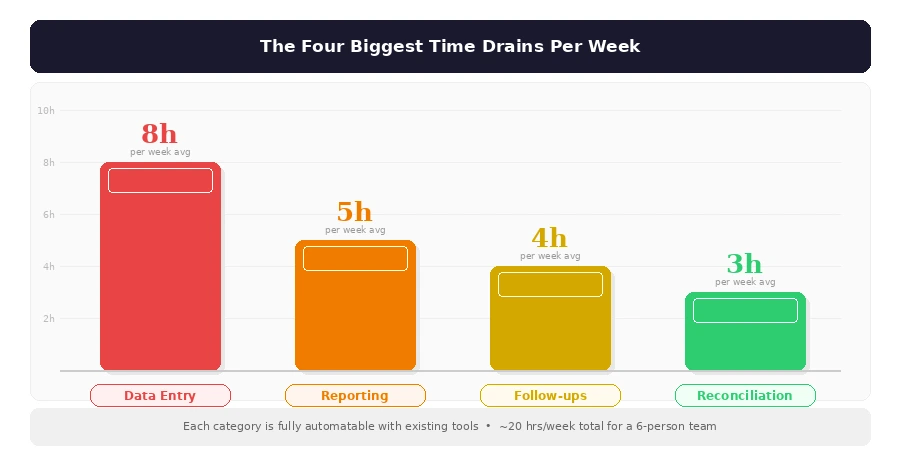
Not all manual processes are equal. Four categories consistently account for the largest share of wasted time:
- Data entry — ~8 hrs/week average
- Reporting — ~5 hrs/week average
- Follow-ups — ~4 hrs/week average
- Reconciliation — ~3 hrs/week average
Each of these is automatable with tools that already exist. The challenge isn't the technology; it's identifying which of these is costing your specific business the most, and sequencing the fixes in the right order.
How to calculate your number
Run this exercise with your team in under an hour. List every recurring manual process, anything that happens daily, weekly, or monthly and involves a human doing something repetitive. For each one, note the time it takes and who does it.
Multiply time by frequency to get weekly hours. Multiply weekly hours by 48 (working weeks) to get annual hours. Multiply annual hours by the fully-loaded cost of the person doing the task, typically £25–£40/hr for most roles in a UK small business.
Now add 20% to account for errors and rework. That's your baseline number. For most businesses doing this exercise for the first time, the result is a figure they've never seen before and a clear case for change.
The trap: knowing the cost but not the fix
Here's where most businesses get stuck. They run the numbers, accept that manual processes are costing them real money, and then, because they don't know exactly which process to fix first or which tools to use, they end up doing nothing. Or they invest in a tool for the wrong process and wonder why the ROI doesn't materialise.
Calculating the cost is necessary. But it's only half the picture. The second half is knowing, with specificity, where your highest-return automation opportunity actually is. That requires a structured view of your operations that most internal teams can't provide objectively because they're too close to the work.
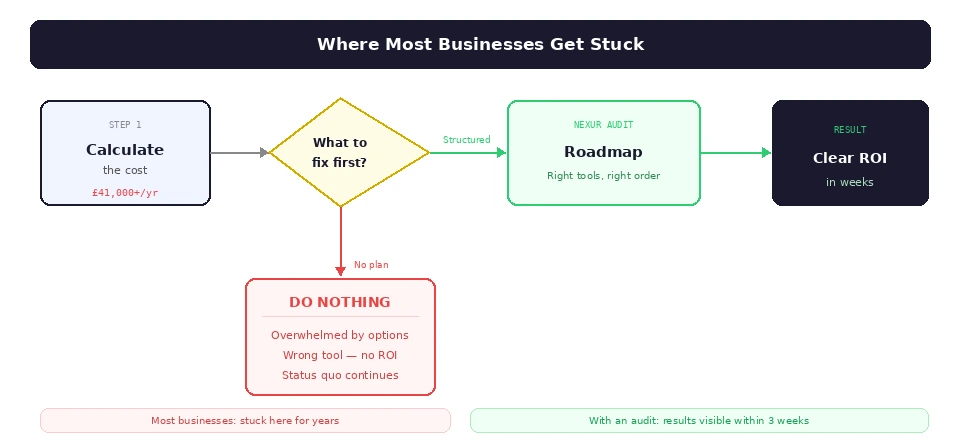
Calculate your cost, then fix the right thing first
Nexur's Automation Readiness Audit maps your operations, quantifies where time and money are being lost, and delivers a prioritised plan telling you exactly which processes to automate first and which tools to use. Delivered in under three weeks, with no jargon.
Currently free as part of our pilot programme. Places are limited.
Keywords