From Whiteboard to Live System: Our End-to-End AI Automation Project Lifecycle
What does a properly run AI automation project actually look like from start to finish? Here is every phase, what happens in it, and why each one matters.

A lot of businesses know they want to automate something. Far fewer understand what a well-run automation project actually looks like from first conversation to live system. This post walks through every phase.
Automation projects fail for many reasons, but one of the most common is that nobody agreed on what the process was supposed to look like before it started. Phases got skipped. Timelines were guessed at rather than planned. The team doing the work and the team using the output were never properly aligned.
A structured project lifecycle solves all of that. It gives every person involved a shared understanding of what is happening, when, and why. It creates natural checkpoints where problems can be caught before they become expensive. And it ensures that by the time anything goes live, it has been properly built, tested, and handed over.
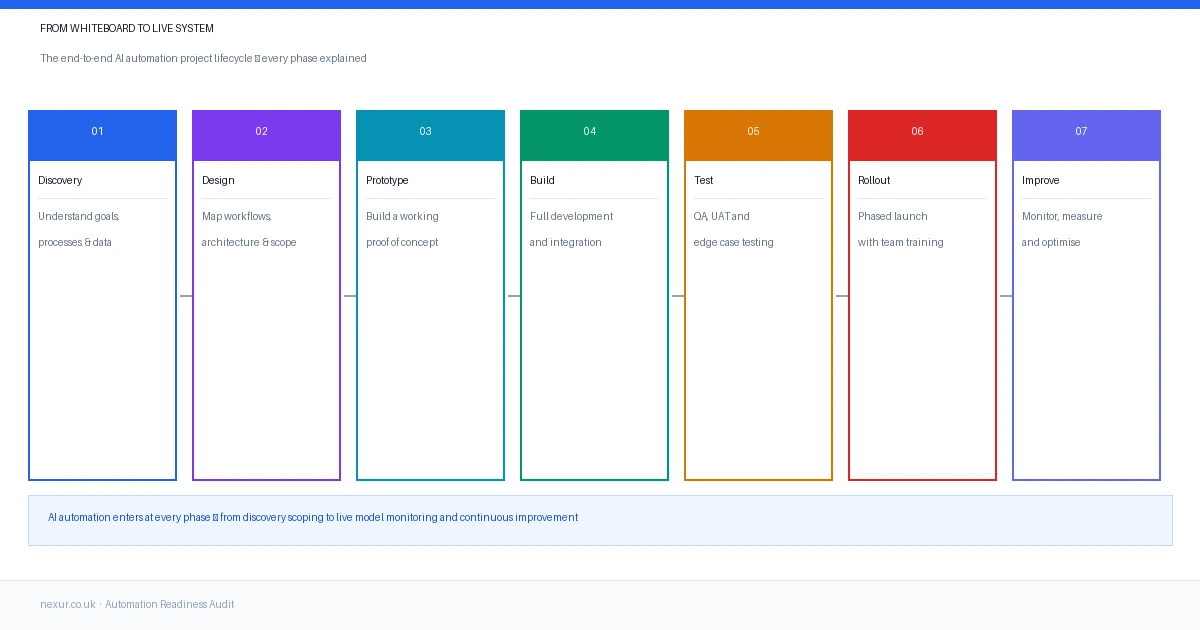
Here is how Nexur runs an end-to-end AI automation project, from the first whiteboard conversation to a live, continuously improving system.
Phase One: Discovery
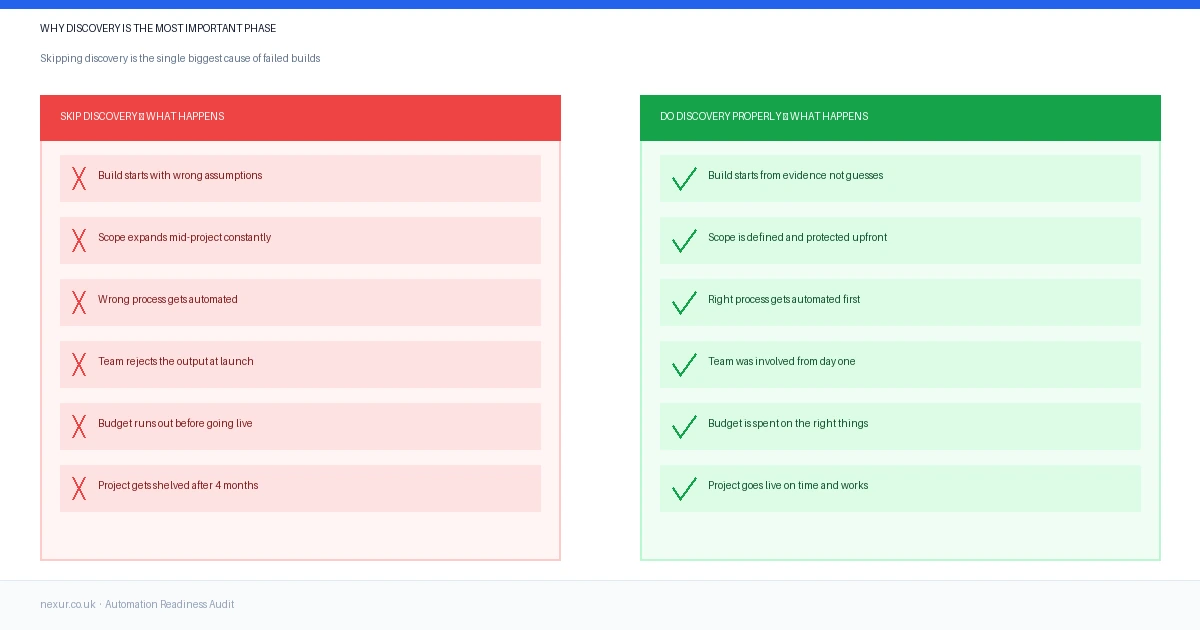
Every well-run automation project starts with discovery. This is the phase where the project team gets a full, honest picture of the current situation, the processes, the systems, the data, the people involved, and the problems that need to be solved.
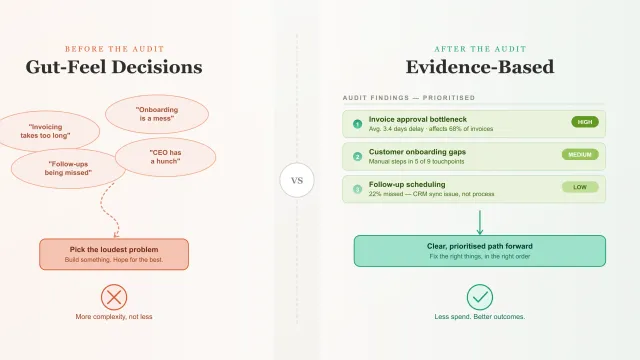
Discovery is not a quick call. It involves structured conversations with the people who actually do the work, a review of existing systems and data, and a clear definition of what success looks like before anything is built. At Nexur, this phase is often preceded by or aligned with our Automation Readiness Audit, which provides the evidence base that makes discovery faster and more precise.
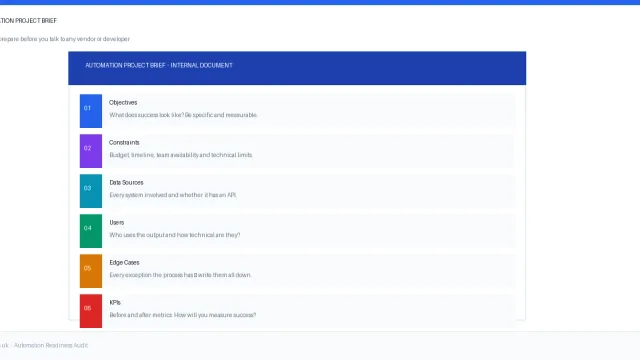
The output of discovery is a signed-off project brief that captures objectives, constraints, stakeholders, data sources, edge cases, and KPIs. Nothing moves to the next phase until this document is agreed.

Featured
From Idea to Live System Without the Guesswork
Most automation projects fail in execution, not ambition. A structured lifecycle ensures every phase—discovery, design, build, and rollout—is validated, tested, and aligned before anything goes live.
Start With a Structured AuditPhase Two: Design
Design is where the solution starts to take shape on paper, not in code. This phase maps out how the automated system will work. Which processes will be automated, in what sequence, and with what logic. How data will flow between systems. Where human intervention will be required and where it will not. What the user experience will look like for the people who interact with the output.
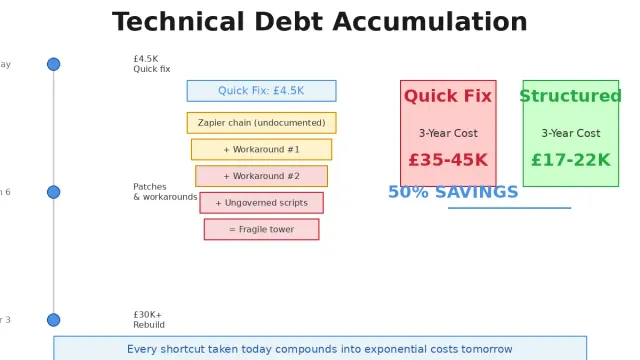
Good design work prevents expensive rework later. A decision made on a whiteboard takes five minutes to change. A decision made in a live system takes five days.
Design also includes architecture decisions. What tools or platforms will be used? How will the automation connect to existing systems? What will happen when something goes wrong? These questions are answered in design, not discovered during build.
Phase Three: Prototyping
Before a full build begins, a working prototype is built to validate the core logic of the solution. This is a deliberate, time-boxed exercise. The prototype is not production-ready. It is designed to answer one question: Does this approach actually work in practice?
Prototyping surfaces problems that design cannot anticipate. An integration that looked straightforward turns out to need an additional authentication step. A data field that was assumed to be consistent across all records turns out to have three different formats. A workflow that looked simple has an edge case that affects 20% of transactions.
These discoveries in a prototype cost hours to fix. The same discoveries during a full build cost weeks.
Phase Four: Build
Once the prototype has validated the approach and any issues have been resolved, the full build begins. This is the phase most people think of when they imagine an automation project the actual development work.
A well-run build phase is structured. Work is broken into defined units. Progress is tracked against the project brief. The client is updated regularly and involved in key decisions. Nothing is assumed.
Build also includes integration work connecting the automation to the real systems it needs to interact with, using the real data those systems contain. This is where the accuracy of the discovery phase pays off. Teams that skipped discovery spend a significant portion of the build phase discovering things they should have known at the start.
Phase Five: Testing
No automation goes live without testing. Testing at Nexur covers three layers.
The first is technical testing: Does the system do what it was built to do? Does every integration work? Does the logic produce the right outputs across all scenarios?
The second is edge case testing, what happens when unusual things happen. The duplicate record. The transaction has a missing field. The approval request comes in at midnight. Real systems encounter these things constantly. The automation needs to handle them gracefully.
The third is user acceptance testing do the people who will use this system agree that it works the way they need it to? This involves real users, real data, and real workflows. It catches the gap between what was specified and what was actually needed, before it becomes a live problem.
Phase Six: Rollout
A phased rollout is almost always better than a big-bang launch. Going live with a subset of users, transactions, or processes first allows problems to be caught and fixed at a manageable scale before the full volume is switched on.
Rollout also includes team training and communication. The people whose daily work is affected by the automation need to understand what has changed, why, and what they are expected to do differently. Automation that launches without this step consistently underperforms because the team works around it rather than with it.
Phase Seven: Continuous Improvement
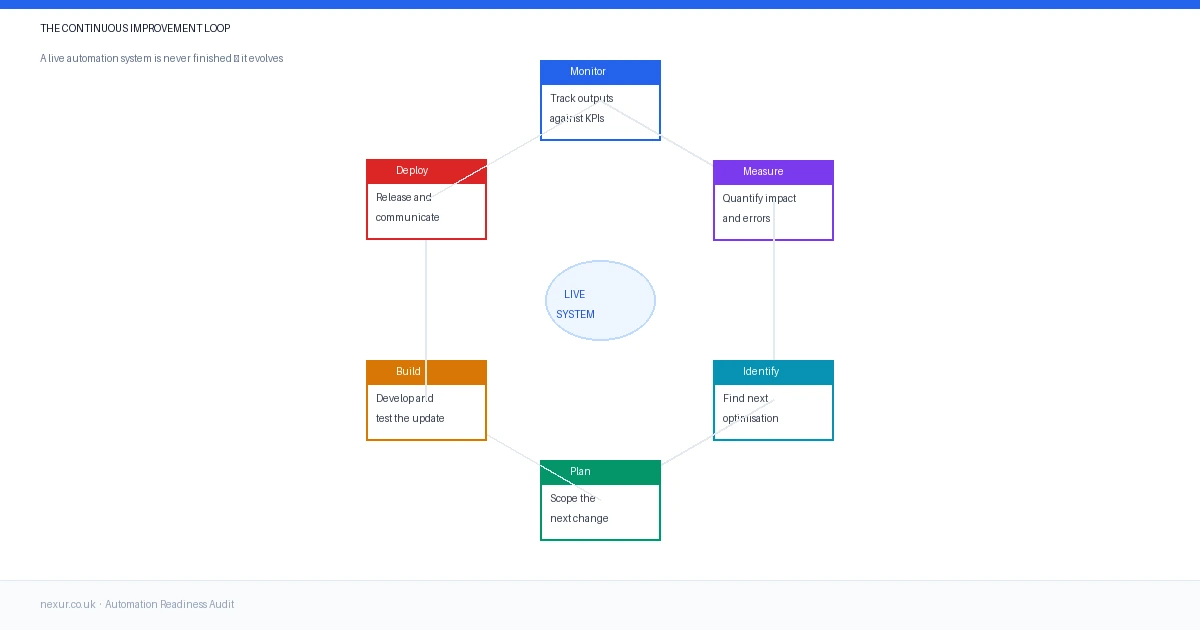
A live automation system is not a finished product. It is the starting point of an ongoing programme. Processes change. Business volumes shift. New edge cases emerge. The data landscape evolves. The automation needs to evolve with it.
Continuous improvement means monitoring the system's outputs against its KPIs on a defined schedule, identifying the next optimisation opportunity, and planning and building improvements in a structured way. This is how the initial investment compounds over time.
Where AI Enters the Lifecycle
AI automation does not replace this lifecycle it operates within it. AI components can appear at multiple phases: in discovery to analyse large volumes of process data, in design to model decision logic, in build to create intelligent processing layers, and in continuous improvement to identify patterns and anomalies in live outputs.
The key point is that AI is a capability layered onto a well-structured process, not a shortcut that removes the need for one. Businesses that try to use AI to skip the hard work of proper project management consistently get worse outcomes than those that do the groundwork first.
What This Means for Your Business
If you are considering an automation or AI project, the most valuable question to ask any delivery partner is: what does your process look like? A partner who can describe a clear, structured lifecycle with defined phases and outputs is a partner who has done this before and knows what it takes to do it properly.
If the answer is "we start with a call and then get building," that is a risk worth thinking carefully about.
Want to understand how this lifecycle applies to your specific situation? Start with a Nexur Automation Readiness Audit it gives you the foundation every phase depends on. Apply for the free audit →
Keywords