How to Find a SaaS Idea People Will Actually Pay For
Finding a SaaS idea is easy. Finding one that deserves to become a real business is the hard part. Here is how to start with the right question.

How to Find a SaaS Idea People Will Actually Pay For
Finding a SaaS idea is not particularly difficult. Spend a little time browsing startup communities, LinkedIn, Reddit, product directories, or even your own workplace and you can probably write down dozens of ideas. The difficult part is finding one that deserves to become a real business.
A product can be beautifully designed, technically impressive, and packed with useful features yet still struggle because the original problem was never important enough. That is why successful SaaS development should begin long before anyone writes the first line of code. It begins with understanding people, workflows, business friction, and the problems customers are already spending time or money trying to solve.
Instead of starting with the question, "What software should I build?", founders should ask a more useful question: "What problem are people already paying to live with?" That shift changes the entire direction of product development.
A Good SaaS Idea Usually Starts With a Problem
Many founders begin with the solution. They imagine a dashboard, a mobile application, an AI feature, an automation platform, or a new marketplace, and then they start looking for people who might use it. The problem with this approach is that it makes it easy to become attached to the product before understanding whether the market actually needs it.
A stronger approach works in the opposite direction. Start with a specific customer, understand what repeatedly causes them frustration, expense, delay, or unnecessary manual work, and only then begin thinking about what kind of software could improve the situation.
Imagine a logistics company where employees spend several hours every morning copying information from emails into spreadsheets. The opportunity is not immediately "build logistics software." The real opportunity is the repeated manual process.
Before thinking about product features, you would want to understand why the work is being done manually, how often it happens, what happens when errors occur, and whether existing tools have already failed to solve the problem. That information begins shaping a much stronger SaaS idea.
Stop Waiting for the Perfect Million-Dollar Idea
The phrase "million-dollar SaaS idea" makes startup opportunities sound mysterious. In reality, many successful software businesses solve problems that look surprisingly ordinary. Scheduling, reporting, approvals, document management, customer follow-up, payments, inventory, internal communication, and data entry are not glamorous topics. But when these problems happen repeatedly across hundreds or thousands of businesses, they become valuable.
The value of a SaaS idea is not determined by how clever it sounds. It is determined by the size, frequency, and financial impact of the problem behind it. Founders looking for profitable SaaS ideas should therefore spend less time asking whether an idea is innovative and more time investigating whether the underlying problem creates measurable friction.
Look Closely at How Businesses Actually Work
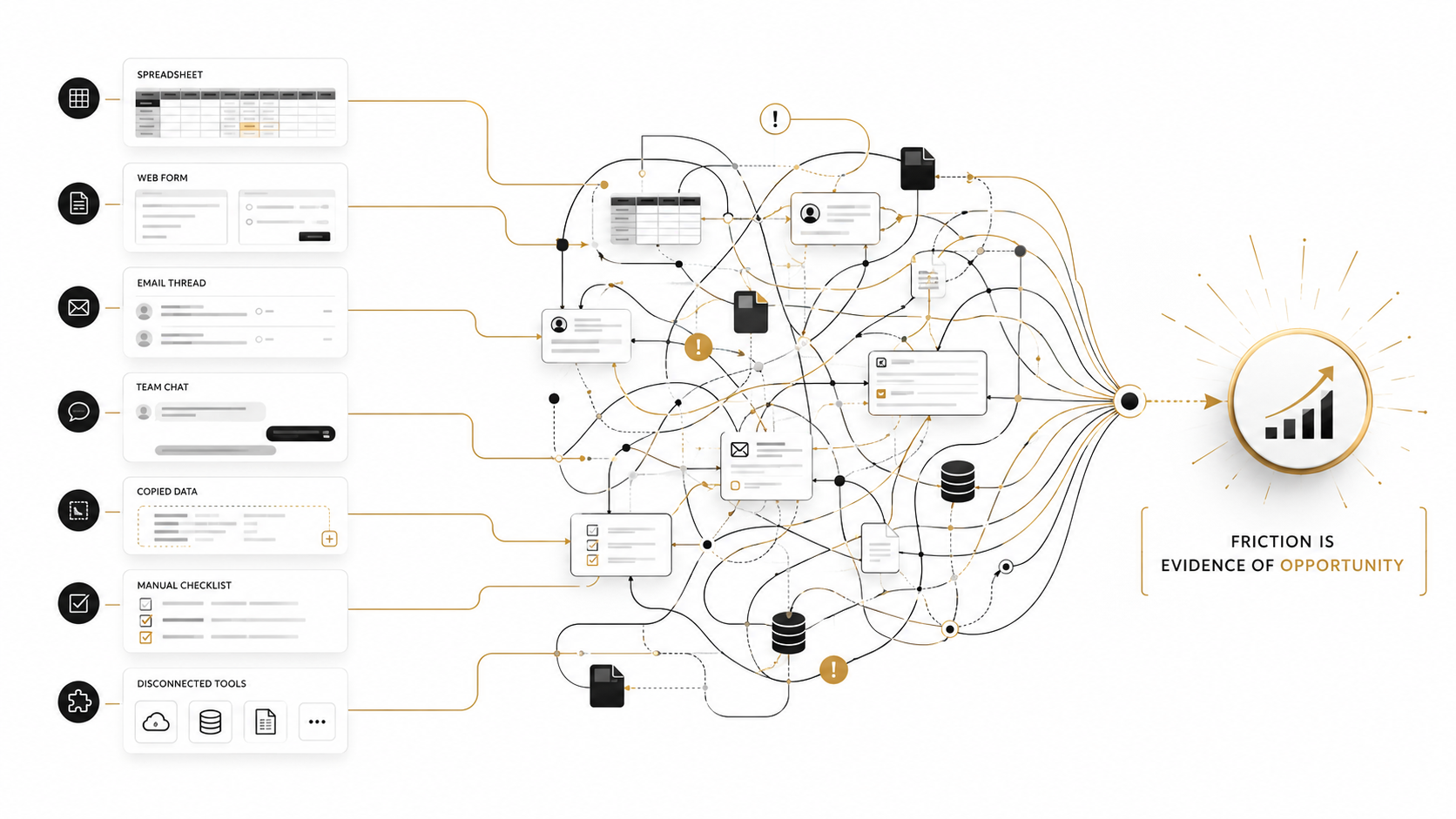
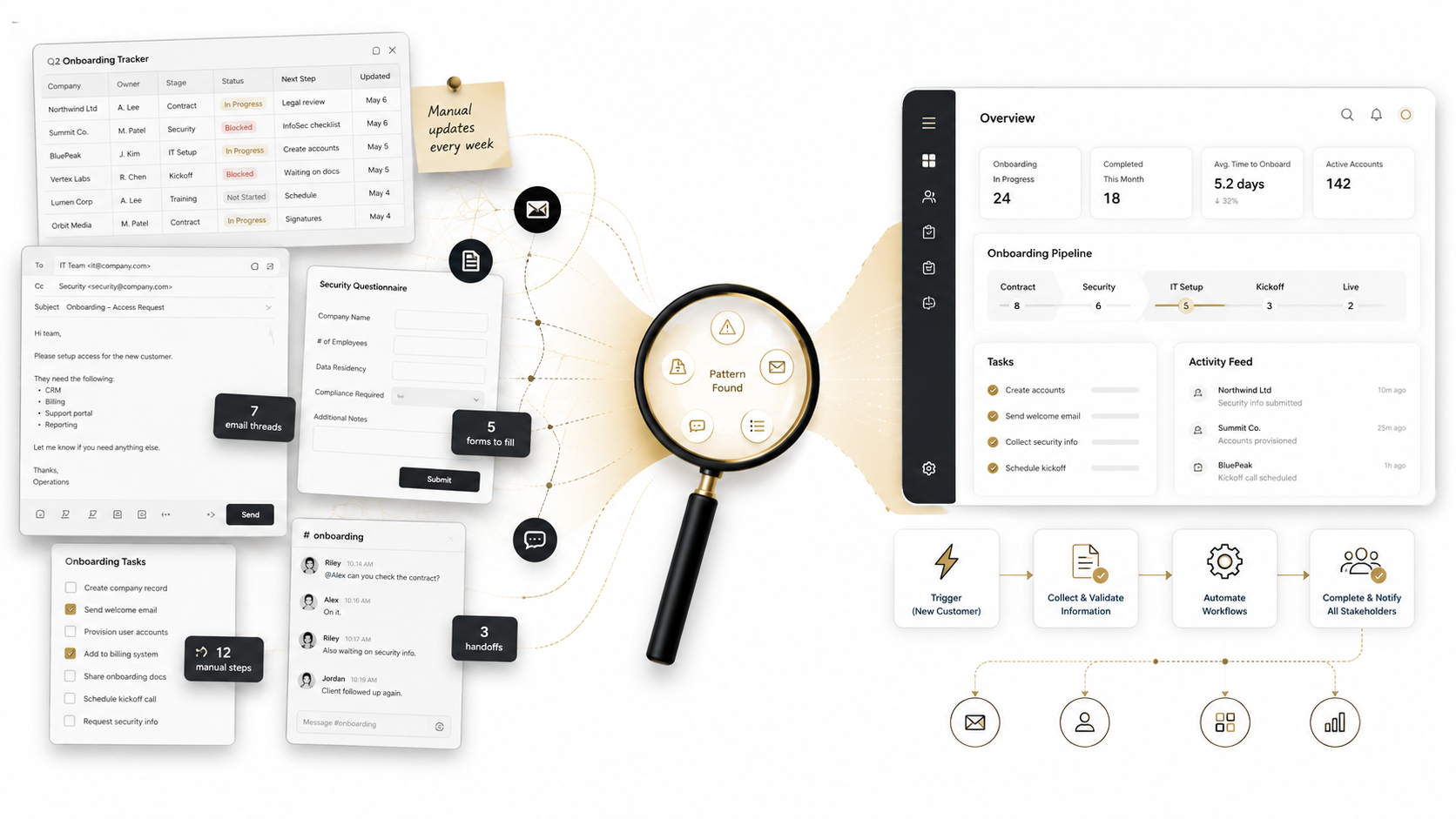
One of the best places to discover SaaS opportunities is inside an ordinary business. Most companies contain processes that were never intentionally designed. A spreadsheet was created as a temporary solution. Someone later added a Google Form. Another employee started using WhatsApp because the internal system was too slow. Someone else exports data from one platform every Friday and manually imports it into another. Over time, these temporary fixes become permanent operations.
That is where founders should pay attention:
- A manual workflow tells you that the problem already exists.
- A complicated workaround tells you that somebody already cares enough to solve part of it.
- When a company is assigning employees, contractors, or software subscriptions to keep that workaround running, you begin to see real evidence of economic value.
This is why understanding business processes should come before choosing the technology.
Workarounds Are Often More Valuable Than Complaints
People complain about many things, but not every complaint should become a software product. A much stronger signal appears when someone has already created a workaround.
- A finance team may maintain a complicated spreadsheet because its accounting software cannot produce a specific report.
- A recruitment agency may have an employee manually moving candidate information between multiple systems.
- A sales team may use email, spreadsheets, and CRM reminders together because no single tool handles its workflow properly.
These behaviours matter because they show action. A workaround tells you that the problem became important enough for somebody to do something about it.
Asking "Would you use software that does this?" is often less useful than asking "How do you currently handle this?" The second question reveals actual behaviour.
The second question can show you what tools are already being used, how much manual work is involved, how frequently the process happens, and what the current method costs. That is the kind of information that helps separate an interesting idea from a real business opportunity.
Find Problems That Have a Cost
A problem becomes much more valuable when doing nothing has consequences. Consider two scenarios:
- Company A: Employees dislike a process because it requires three extra clicks.
- Company B: Staff spend thirty hours every month preparing reports manually and errors regularly delay customer invoices.
Both businesses have a problem, but only one has an obvious financial reason to pay for a better solution. The strongest problems usually connect to a meaningful business outcome — they may save time, reduce operating costs, increase revenue, reduce risk, improve customer experience, or help employees complete important work more efficiently.
If you cannot clearly explain why solving the problem creates value, selling the software will eventually become difficult.
Your Existing Job Can Be a Great Source of SaaS Ideas
Founders sometimes assume they need to discover an entirely new market. In reality, domain knowledge can be a major advantage. If you have spent years working in healthcare, logistics, finance, recruitment, property, construction, or professional services, you have probably seen problems outsiders would never notice.
You understand how the industry speaks. You know where delays happen. You know which systems people dislike using. You know which spreadsheets everybody depends on. You understand which processes are tolerated simply because people assume there is no better way. That context can be far more valuable than entering a fashionable market simply because it is growing.
Do Not Confuse Positive Feedback With Validation
Early feedback can be dangerously encouraging. You explain your SaaS idea and someone says, "That sounds great." Another person says, "I would definitely use that." Those comments feel like validation, but they are not.
Real SaaS validation requires stronger signals — ranked from weakest to strongest:
| Signal | Strength |
|---|---|
| "That sounds great!" | Very weak |
| Spending 30 mins showing you their current workflow | Moderate |
| Agreeing to join a pilot | Strong |
| Introducing you to the budget owner | Stronger |
| Willing to pay | Most meaningful |
The closer you move from compliments to commitment, the stronger your validation becomes.
Validate the Offer Before Building the Entire Product
A common founder mistake is assuming validation requires a complete MVP. It does not. Before building a full platform, you can often test whether customers understand and value the core proposition:
- A landing page can explain the outcome.
- A clickable prototype can demonstrate the workflow.
- A manual service can temporarily deliver the result your future software will automate.
- A product walkthrough can help you understand which parts of the solution customers care about most.
The objective is not to pretend the product is finished. The objective is to reduce uncertainty before development becomes expensive.
Keep the First Version Smaller Than You Want
Founders are usually very good at imagining what a product could eventually become. That often makes version one unnecessarily complicated.
Suppose your research shows that small property-management companies struggle to collect maintenance requests from tenants and assign them to contractors. It is easy to imagine a complete platform with tenant apps, contractor portals, payments, analytics, AI support, messaging, property dashboards, and document storage. But customers may initially care about only one thing: getting maintenance requests assigned and resolved without chasing people through email and WhatsApp.
A smaller product is not necessarily a weaker product. A focused product can deliver a clearer result, launch faster, and generate better feedback because users understand exactly what it is supposed to solve.
Design the User Journey Before Adding Features
Once demand exists, the next challenge is turning the solution into something people can actually use. Complex software often fails not because the underlying technology is weak, but because customers struggle to understand what to do next.
A good product journey should make the important action obvious. The user should know:
- What happens when they first sign in
- What information they need to provide
- What the next step is
- What happens if something goes wrong
These questions are especially important for SaaS dashboards, workflow applications, and business systems where users may interact with several screens and processes.
Technology Should Follow the Business Requirement
The technology stack matters, but it should not be the first strategic decision. React, Next.js, Node.js, .NET, Python, PostgreSQL, cloud infrastructure, and APIs can all be excellent choices depending on the type of product being built.
The important question is not which technology sounds most modern. The real question is which architecture gives the product the reliability, scalability, and maintainability it actually requires.
A B2B SaaS platform handling sensitive operational data may require a very different architecture from a simple consumer-facing prototype. A product that needs to integrate with CRM, ERP, payment, or communication systems should consider those requirements early rather than trying to bolt them on after launch.
AI Should Solve a Problem, Not Become the Idea
AI has created an enormous number of new SaaS opportunities. It has also created many products whose only differentiation is that they contain AI. That is not enough. Customers rarely wake up wanting "AI." They want a result:
- Faster customer support
- Fewer repetitive tasks
- Better forecasting
- Automatic document processing
- Stronger lead follow-up
- Less administrative work
If AI is the best way to create that outcome, it can become extremely valuable. But the business problem should still come first.
The Best SaaS Idea Is the One You Can Prove
There is no formula that guarantees a million-dollar SaaS business, but there is a much stronger process than guessing. The best opportunities usually begin with:
- A specific customer
- A recurring problem
- A current workaround
- A measurable cost
- Some form of customer commitment
The irony is that the strongest SaaS ideas often do not feel revolutionary when you first discover them. They feel obvious. A broken workflow that should be simpler. A manual process that should be automated. A business task that should not take three hours. An existing system that everybody tolerates but nobody enjoys using. That is often where the real opportunity lives.
Instead of asking, "What million-dollar SaaS idea can I invent?", ask a more commercially useful question: "What valuable problem can I understand better than everyone else?"
Once you have evidence that the answer is worth pursuing, that is when product strategy, design, and development should begin.