Why Small Businesses That Automate in 2026 Will Leave Everyone Else Behind
AI and automation are no longer just for enterprise. The businesses acting now are building an operational advantage that will be nearly impossible to close.

For the past decade, automation and AI were the preserve of large enterprises, companies with the budget for consultants, developers, and six-month implementation projects. That's no longer true. In 2026, the tools exist. The costs have dropped dramatically. And the businesses that move first are quietly building an operational advantage that will be very difficult to replicate later.
The Automation Gap Is Widening Fast
A few years ago, the automation gap between large and small businesses was bridgeable. Big companies had automation, but their advantages were offset by their sluggishness, bureaucracy, and cost base. Small businesses could compete on speed, relationships, and agility.
That balance is shifting. Large businesses are now automating and staying agile, using AI tools to compress their admin burden, speed up customer responses, and generate insights from data that would have previously required an entire analytics team. Meanwhile, many small businesses are still running on spreadsheets, email chains, and manual processes they've never had time to question.
The gap isn't just about efficiency. It's about compounding. Every month a business runs leaner operations, those savings get reinvested. Every month a competitor doesn't, the distance grows.
What Small Business Automation Actually Looks Like in 2026
The word "automation" still conjures images of factory robots or enterprise software that takes 18 months to implement. That perception is outdated. For a small business in 2026, automation typically looks like this:
- Customer follow-ups that trigger automatically after a sale, enquiry, or missed appointment, without anyone remembering to send them.
- Invoice generation and chasing that runs on its own schedule, reducing late payments without awkward phone calls.
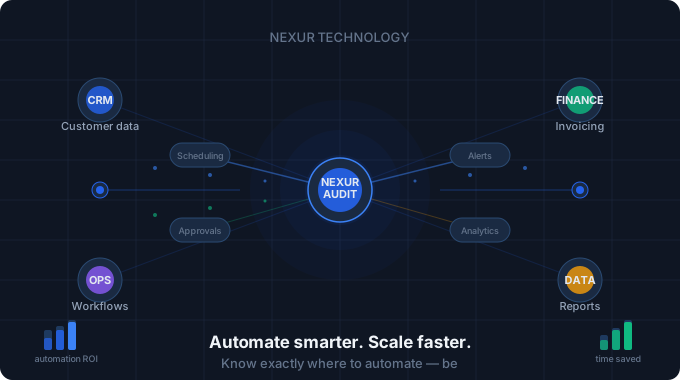
- Data that flows between systems CRM, accounting, operations, without manual copying between tools.
- Reporting dashboards that update in real time, so you're making decisions from live data rather than last month's spreadsheet.
- AI-assisted customer service that handles routine queries at any hour, freeing your team for conversations that actually need them.
None of these require a developer on staff or a six-figure budget. They require knowing where to start, which is the part most businesses get wrong.
The Biggest Mistake: Automating The Wrong Things First
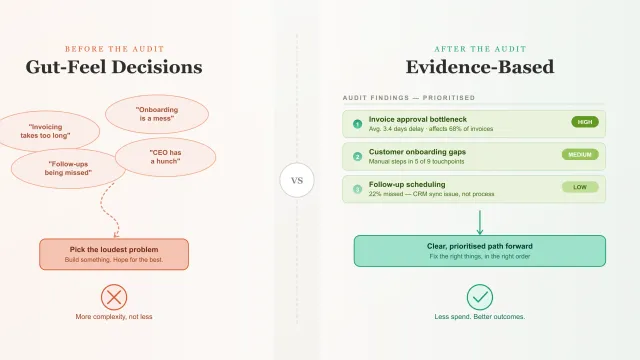
Here's what typically happens when a business decides to "start automating." They pick a tool they've seen advertised, implement it for a process that felt painful, and three months later they've spent time and money on something that's saved them four hours a week, while a different process is still haemorrhaging 20.
The ROI of automation isn't evenly distributed. Some processes deliver 10x returns when automated. Others barely justify the setup time. The difference isn't obvious from the inside, it requires stepping back and mapping the full picture of where time, money, and errors are actually going.
This is the core problem that most small business owners face: not a lack of tools, but a lack of clarity on where to point them.

Featured
Build the Automation Advantage Your Competitors Will Struggle to Catch
In 2026, the gap isn’t between big and small businesses—it’s between those who automate with clarity and those who guess. Identify your highest-impact automation opportunities before inefficiencies compound further.
Discover Your Automation AdvantageWhy 2026 Is The Right Time And Why Waiting Is Expensive
There's a timing argument that most business owners haven't fully internalised. Automation isn't just about current savings it's about compounding returns over time. A business that identifies and implements its top three automation opportunities in Q1 2026 will have a year of compounded efficiency gains by Q1 2027. A business that waits until 2027 to start begins from scratch with a year's deficit.
Beyond the compounding effect, there's a talent dynamic shifting in parallel. As automation becomes standard, employees expect it. Businesses still running entirely on manual processes will find it harder to attract and retain good people not because of pay, but because good operators don't want to spend their days doing work a computer could handle.
The window isn't closing overnight. But it is closing.
The Right First Step: Know Before You Build
The most effective way to start isn't to pick a tool. It's to get an independent, structured view of your operations, one that tells you, with evidence, where automation will deliver the most value in your specific business.
That's the difference between businesses that see real ROI from automation and those that don't. It's not the tools they chose. It's the clarity they had before choosing them.
Find Out Exactly Where Your Business Should Automate First
Nexur's Automation Readiness Audit is a structured, consultant-reviewed assessment of your operations, processes, and team. It tells you exactly where automation will save you the most time and money, and where it won't. Delivered in under three weeks.
Currently available free as part of Nexur's pilot programme. Limited places.
Keywords