Technical Debt in Automation: How Quick Fixes Today Become Expensive Problems Tomorrow
The every shortcut in automation builds up a hidden bill. Here is what technical debt looks like in practice, how it compounds over time, and how to avoid it.

Technical Debt in Automation: How Quick Fixes Today Become Expensive Problems Tomorrow
Every automation shortcut that saves time today creates a hidden cost that compounds quietly in the background until it does not stay hidden anymore.
Technical debt is a concept from software development. It describes the hidden cost of taking shortcuts in how a system is built. The shortcut works in the short term. But it creates structural weakness that makes future changes harder, more expensive, and more likely to break things.
In automation, technical debt is everywhere. And unlike in traditional software development, where at least the debt is usually visible to someone on the engineering team, automation debt often accumulates completely out of sight in scripts nobody owns, in Zapier chains nobody documented, in cloud functions that run every day but that nobody is quite sure how to modify without breaking.
This post explains what automation technical debt looks like in practice, why it compounds faster than most people realise, and what a structured approach to automation prevents.
What Automation Technical Debt Actually Looks Like
Technical debt in automation is not abstract. It shows up in specific, recognisable ways that most growing businesses will find familiar.
The Zapier chain nobody dares touch. It was built two years ago by someone who has since left. It does something important sends customer confirmation emails, or syncs orders to the fulfilment system. Nobody fully understands it. Everyone is afraid to modify it because the last time someone tried, it broke and customers did not receive their order confirmations for three days. So it just keeps running, and when something slightly outside its original scope needs to happen, a workaround is bolted on.
The script running in production with no documentation. A developer wrote it to solve a specific problem. It runs on a schedule. It works most of the time. But nobody has documented what it does, what systems it touches, or what happens if it fails. When a new system gets introduced that changes the data format it expects, it fails silently. Nobody notices until a report is wrong and the finance manager spends a week trying to understand why.
The ungoverned cloud function. Someone spun up a cloud function to handle a specific task. It ran fine for months. Then the API it was calling changed its authentication method. The function started failing. Because nobody was monitoring it, the failures went unnoticed for several weeks. By the time the issue was identified, a significant amount of data had not been processed.
Each of these examples represents a piece of automation that was built quickly, without a proper structure, and is now creating ongoing costs and risks.
Why It Compounds
The dangerous thing about automation technical debt is not any single piece of it. It is how the pieces interact and accumulate.
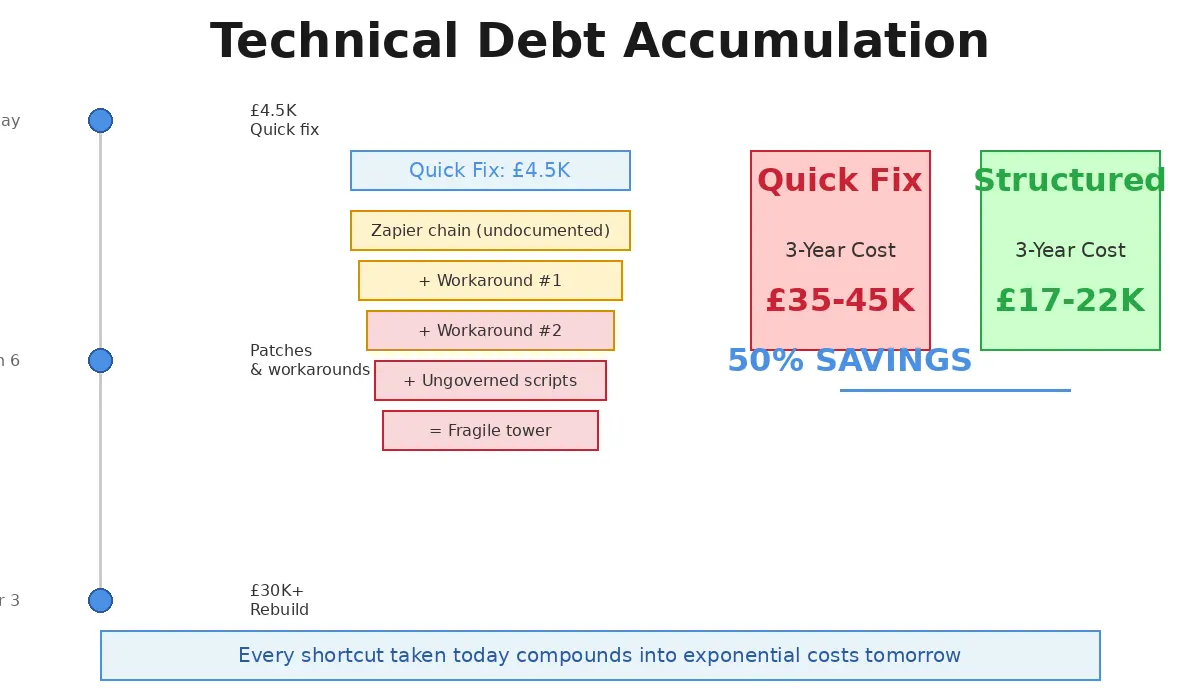
A brittle Zapier chain gets patched with a workaround. The workaround creates a dependency on a specific data format. A new tool is introduced that uses a slightly different format. The chain breaks. A new workaround is added. Now there are two dependencies, two fragility points, and two pieces of code that nobody fully understands.
Each patch adds complexity. Each addition to complexity increases the likelihood of a future failure. Each failure costs time to diagnose, time to fix, and time lost while the underlying process is not running.
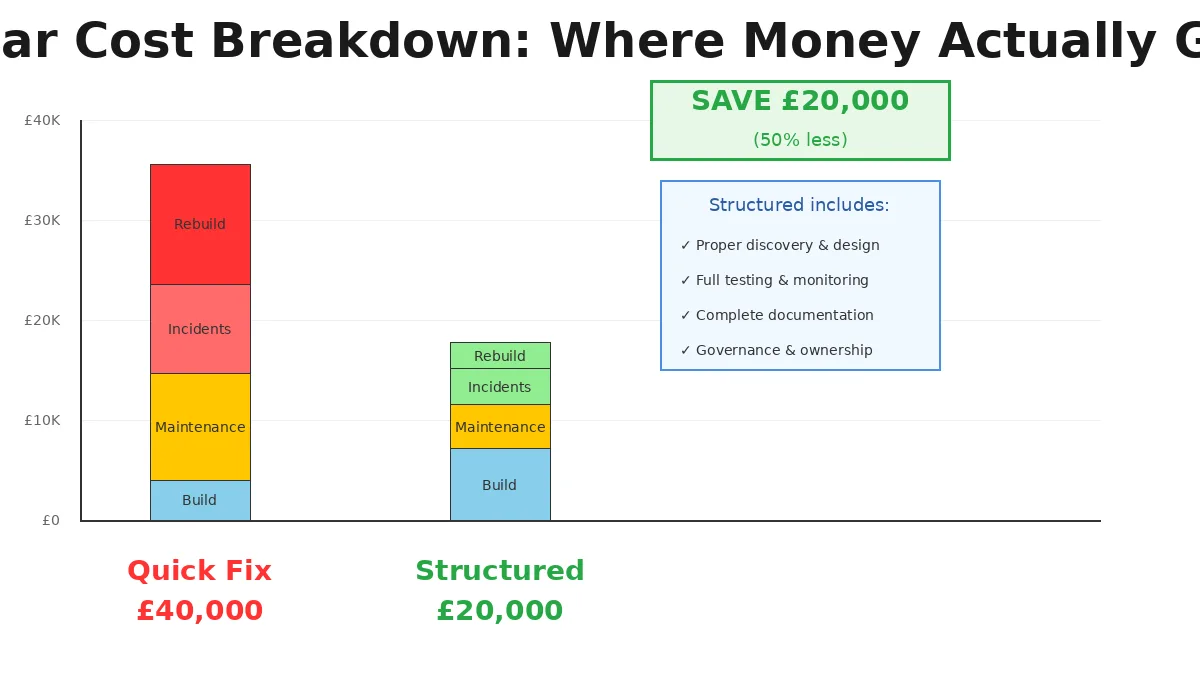
Over three years, a set of automation quick fixes that cost £4,500 to build can easily accumulate £30,000 or more in maintenance, incident response, and eventual rebuild costs. The original £4,500 was not a saving. It was a loan taken out at a very high interest rate.
The Six Most Common Forms of Automation Debt
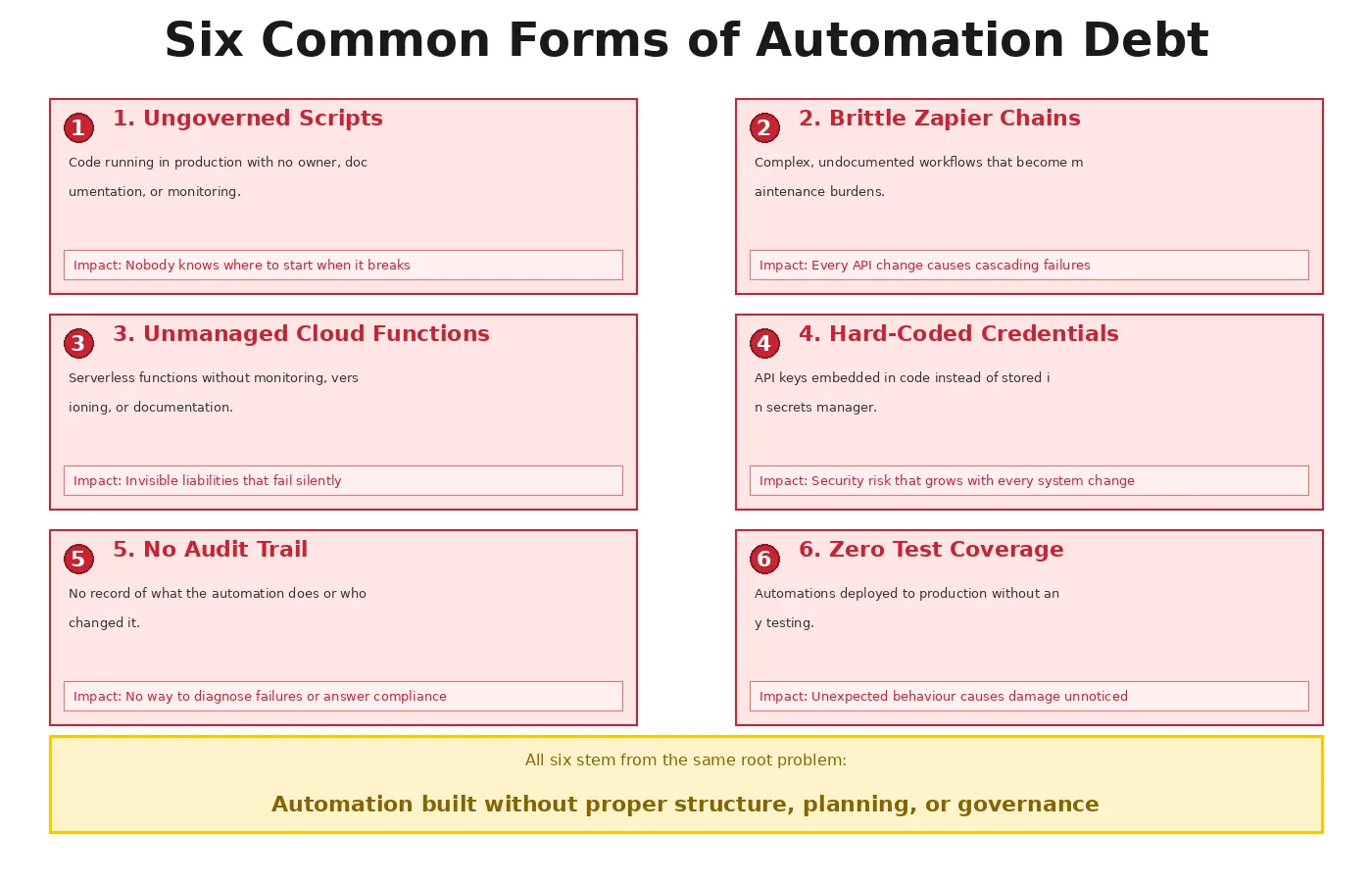
Based on what surfaces in readiness audits and delivery engagements, here are the six most common forms of automation technical debt:
Ungoverned scripts. Code running in production with no owner, no documentation, and no monitoring. When it breaks, nobody knows where to start.
Brittle Zapier and no-code chains. Automation tools are excellent when used properly. When they are used to build complex, undocumented workflows, they become a maintenance burden that grows every time a connected system changes.
Unmanaged cloud functions. Serverless functions are powerful, but they require the same governance as any other piece of production code. Without monitoring, versioning, and documentation, they become invisible liabilities.
Hard-coded credentials and API keys. Credentials embedded directly in automation code rather than stored securely in a secrets manager. A security risk that grows as systems change and old credentials pile up.
No audit trail or change log. No record of what the automation does, when it was changed, or who changed it. When something goes wrong, there is no way to diagnose it quickly. When a compliance question arises, there is nothing to show.
Zero test coverage. Automations deployed to production without any testing. Edge cases go undetected until they appear in real data, often causing damage before anyone notices.

Featured
Stop Small Automation Fixes From Becoming Expensive System Failures
Quick automation shortcuts often turn into long-term technical debt—fragile workflows, hidden dependencies, and costly breakdowns. Identify and eliminate these risks before they compound in your systems.
Audit Your Automation DebtWhat a Structured Lifecycle Prevents
Every item on that list is the result of the same underlying problem: the automation was built without a proper structure. No discovery phase to understand the requirements properly. No design phase to architect the solution soundly. No testing to validate it works across all cases. No governance framework to control and monitor it once live.
A structured project lifecycle, of the kind described in our previous post on end-to-end delivery, prevents all of these problems at source. The cost of building properly is higher upfront. But the three-year total cost is dramatically lower.
A quick fix approach typically costs between £35,000 and £45,000 over three years when maintenance, incidents, and the eventual rebuild are factored in. A structured approach to the same scope typically costs between £17,000 and £22,000 and leaves you with a system that is documented, monitored, and designed to evolve without breaking.
How to Tell If You Already Have a Debt Problem
Run a quick audit of your current automations. Ask these questions about each one:
Does it have a named owner who is responsible for it today? Is there documentation that describes what it does, step by step? Is it monitored, and do alerts fire if it fails? Has it been tested against the scenarios it encounters in real life? Could it be modified safely by someone other than the person who built it?
If the answer to most of these questions is no, you have a debt problem. The sooner it is addressed, the cheaper the fix will be. Automation debt does not stabilise on its own. It compounds.
An automation readiness audit will surface any existing debt in your current setup. Nexur's audit includes a review of your existing automations alongside new opportunities. Apply for the free audit →
Keywords