Is Your Business Ready To Automate? 5 Signs You Shouldn't Ignore
Most small businesses waste thousands of hours on tasks a machine could handle. Here are 5 clear signs your business is ready to automate.


You're running a growing business. You've got spreadsheets open in fifteen tabs, a team that's always chasing its tail, and a nagging feeling that there has to be a better way. Sound familiar? You're not alone, and the answer might be automation. But how do you know if your business is actually ready for it?
That's the question most small business owners skip straight past. They either jump into automation tools without a plan and waste money, or they dismiss it entirely, assuming it's only for big enterprises with big budgets. Neither approach serves you well.
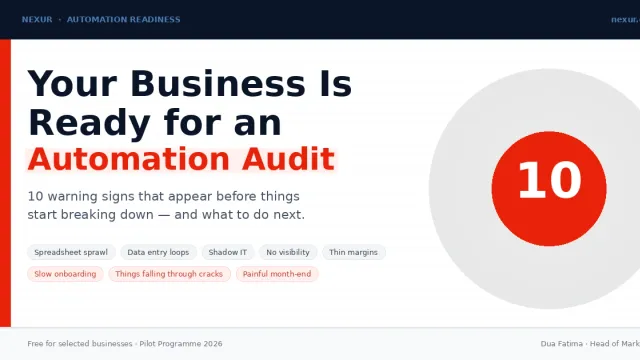
Here are five clear signs that your business is ready to automate, and what to do when you spot them.
Figure: Automation can free your team to do higher-value work.
1. Your Team Keeps Doing The Same Tasks Over And Over
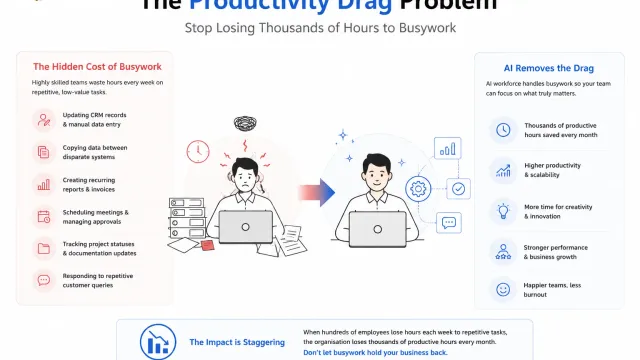
If you can describe a task in a series of "if this, then that" steps, there's a good chance it can be automated. Think about data entry, sending follow-up emails, generating invoices, or updating spreadsheets after a sale. These repetitive processes don't require human judgment, they just require human time. And that time is expensive.
 Automate repetitive tasks to reclaim hours every week.
Businesses that are automation-ready usually have several of these recurring workflows already, they're just doing them manually because no one has stopped to question it.
2. Human Error Is Costing You Time And Reputation
The wrong invoice was sent to the wrong client. A follow-up email that never got sent. A discount was applied when it shouldn't have been. Mistakes happen, but when they happen because a human is tired, distracted, or overwhelmed, that's a process problem, not a people problem.
If your team is regularly firefighting errors that stem from manual processes, you're already paying the hidden cost of not automating. The good news: these are often the easiest wins to fix.
Automation reduces manual mistakes and improves reliability.
3. You're Struggling To Scale Without Adding Headcount
Growth is great until your processes buckle under the weight of it. If every new customer or new order means proportionally more admin, more manual steps, and more strain on your team, your operations aren't built to scale. You'll hit a ceiling.
Businesses ready for automation usually reach a point where hiring another person to manage volume feels cheaper than solving the underlying process problem — but it isn't. A well-placed automation can handle the work of multiple people for a fraction of the cost.
4. Your Data Lives In Too Many Places
A CRM here. A spreadsheet there. An inbox full of orders. A project management tool that nobody updates consistently. If pulling together a clear picture of your business requires visiting five different places and reconciling conflicting information, you're operating blind, and you're not alone.
Fragmented data is one of the clearest signals that a business could benefit from structured automation. When your systems talk to each other:
5. You Know Something Needs To Change, But You Don't Know Where To Start
Sometimes the clearest sign isn't a specific problem, it's a feeling. A growing sense that your operations are messier than they should be, that your team is stretched too thin, that you're making decisions based on gut feel rather than data.
That instinct is worth trusting. It's usually a sign that your business has outgrown its current processes and is ready for a more structured approach.
So You Recognise The Signs, What Next?
Knowing that automation could help is only half the battle. The harder question is: where exactly should you automate first?
Jump into the wrong area, and you'll spend time and money on tools that don't move the needle. Start in the right place, and you'll see ROI within weeks.
Right now, the Automation Readiness Audit is available free as part of Nexur's pilot programme; with limited places.
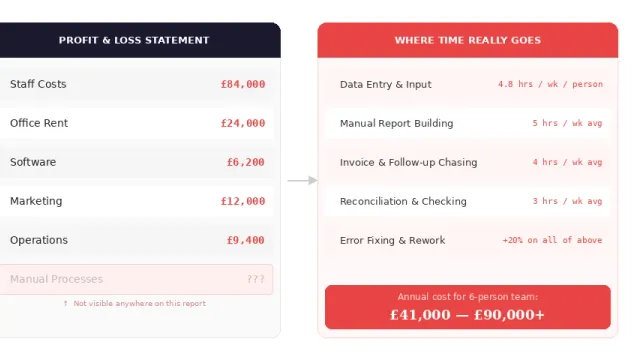
Nexur's Automation Readiness Audit maps your operations, quantifies where time and money are being lost, and delivers a prioritised plan telling you exactly which processes to automate first and which tools to use. Delivered in under three weeks, with no jargon.
Currently free as part of our pilot programme. Places are limited.

Featured
Don’t Guess What to Automate - Get a Clear Starting Point
If repetitive tasks, scattered data, and scaling issues are slowing your business down, you’re already automation-ready. The real question is what to fix first, our audit gives you a prioritized roadmap in weeks, not months.
Check Your Automation ReadinessKeywords