Why 'Just Build Me a Bot' Fails: The Importance of Process Design Before Development
Throwing automation at a broken process does not fix it. It makes the broken process run faster. Here is why process design must come before development every time.

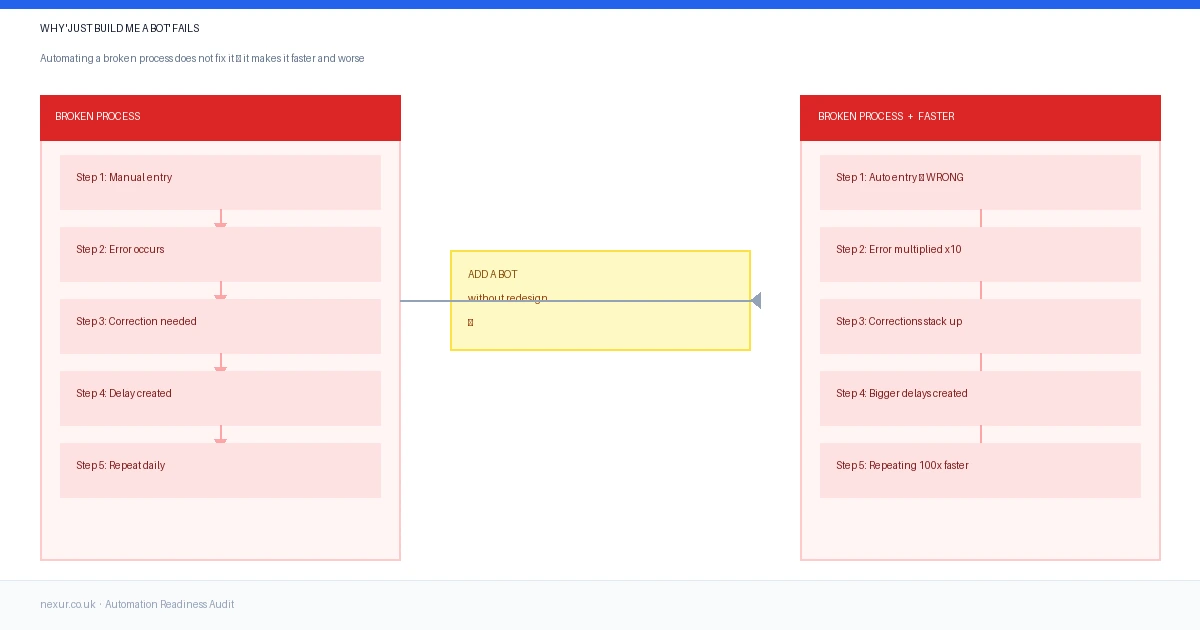
Automating a broken process does not solve the problem. It makes the problem happen faster, at greater scale, with less human ability to catch it.
It is one of the most common requests in automation. A business identifies something painful. Usually something repetitive, time-consuming, and error-prone, and asks for a bot to handle it. The thinking is straightforward. Humans are doing this badly. A machine will do it faster and more consistently. Problem solved.
Except it usually is not solved. And in many cases, things get worse.
The reason is simple. When you automate a process, you take whatever is happening in that process and make it happen at machine speed, at machine scale, without a human in the loop to notice when something has gone wrong. If the process is well-designed and the logic is sound, that is powerful. If the process has problems, and most manual processes do, you have just built a system that runs those problems faster than you can catch them.
This post explains why process design must always come before development, what good process design looks like, and how to tell whether your process is actually ready to be automated.
The Fundamental Mistake: Treating Automation as a Fix
The most common misunderstanding about automation is that it is a solution to operational problems. It is not. It is an amplifier of whatever is already happening in your operations.
Give automation a good process and it amplifies the good. Work gets done faster. Errors reduce. Capacity increases. The team is freed up for higher-value work.
Give automation a bad process and it amplifies the bad. Mistakes happen faster and at greater volume. The errors that a human would have caught on their second pass through the inbox now get processed automatically and sent to a hundred customers before anyone notices.
This is not a theoretical risk. It is a pattern that plays out regularly in businesses that skip process design.
What a Broken Process Actually Looks Like
It relies on one person's memory. If the process only works because a specific individual knows all the steps, exceptions, and unwritten rules, it is not a process.
It has undocumented exceptions. Decisions are inconsistent and based on instinct.
It produces different outputs depending on who runs it. Lack of standardisation makes automation risky.
Steps exist for historical reasons no one can explain. Legacy logic often survives unnecessarily.
It involves copying data from one place to another. This usually signals a systems problem, not a process problem.
How to Redesign a Process Before You Automate It
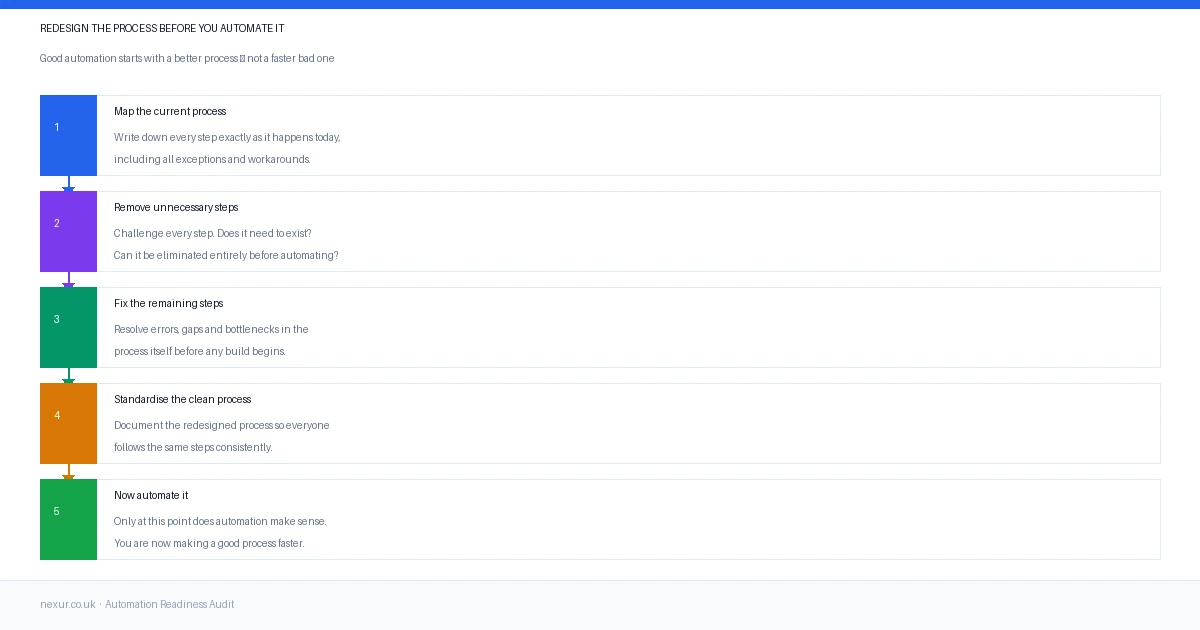
Step one: Map the current process exactly as it is.
Step two: Challenge every step.
Step three: Fix the remaining steps.
Step four: Standardise the redesigned process.
Step five: Now automate it.

Featured
Don’t Automate the Problem—Fix the Process First
Building a bot on a broken workflow only scales errors faster. Get a clear, structured view of your processes so you know what’s ready for automation—and what needs redesign before development begins.
Validate Your Processes FirstThe Costs of Getting This Wrong
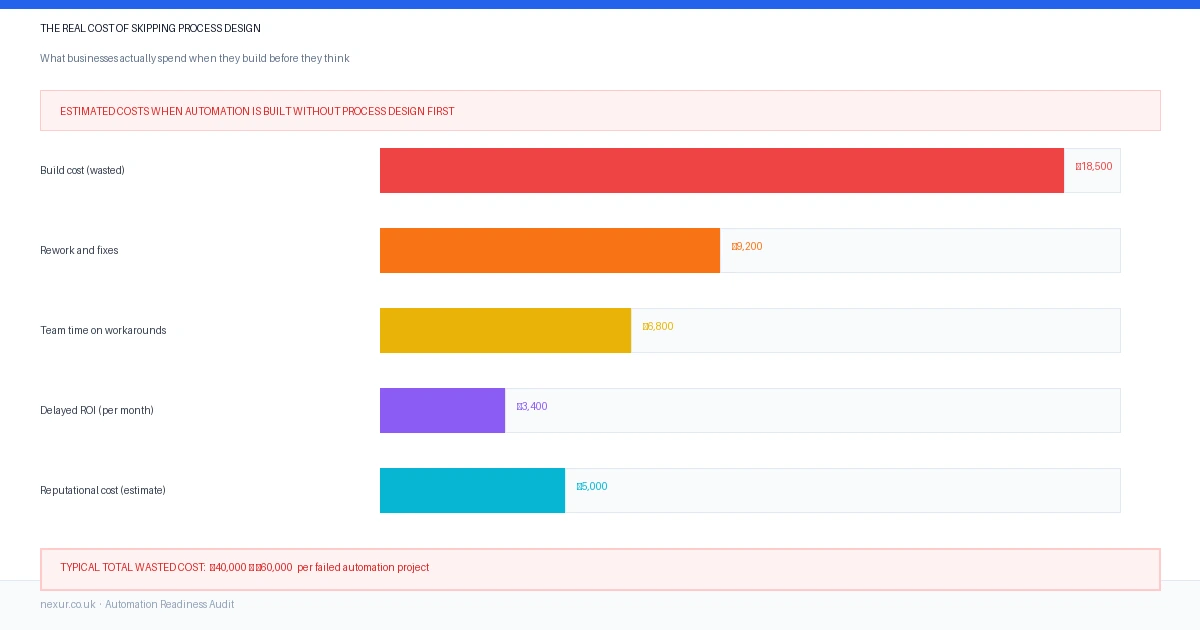
Failed automation typically costs between £15,000 and £30,000 for mid-complexity builds, not including operational disruption.
Beyond money:
- Delayed efficiency gains
- Ongoing operational friction
- Reduced trust in automation initiatives
What to Ask Before Any Build Starts
- Have we mapped the current process in full, including exceptions?
- Are we automating the process as it is, or as it should be?
How an Automation Audit Helps
An audit clarifies readiness before development starts, identifying what can be automated safely and what requires redesign.
Before you build anything, make sure you are building the right thing.
Nexur's Automation Readiness Audit maps your processes and tells you exactly what is ready, and what is not.
Apply for the free audit →