Why Your Business Needs an AI Workforce and How to Build One
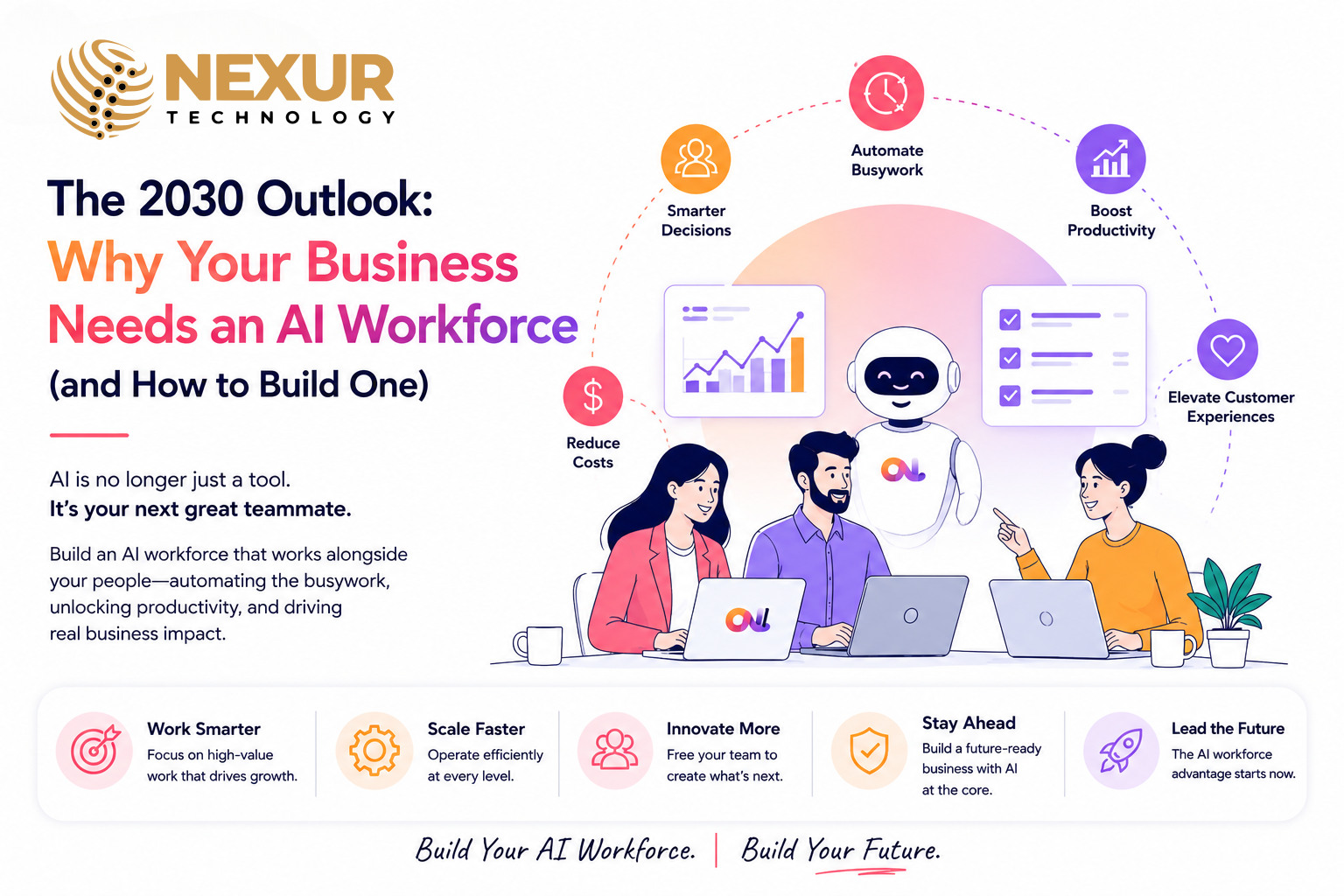
By 2030, AI will no longer be just a tool. It will become a digital workforce layer helping businesses reduce busywork, scale operations, and improve decision-making.

1. The Shift: From Tools to Teammates
Artificial Intelligence is transcending its origins as a reactive interface, evolving from a mere tool into a foundational pillar of the modern enterprise.
This is not merely a technical upgrade. It is a profound transformation occurring behind the scenes of the world’s most resilient organisations. We are moving away from an era of isolated software applications and toward a future defined by the AI Workforce: networks of intelligent systems that function as teammates, working alongside humans to drive innovation.
By the year 2030, this transition will no longer be a competitive advantage for the few. It will be the industry standard.
The businesses that thrive will be those that stop viewing AI as a chatbot and start treating it as a digital workforce capable of analysing information, coordinating complex operations, and supporting high-level decision-making in real time.
2. The Productivity Drag Problem
Many business leaders believe they are facing a productivity crisis. In reality, they are suffering from a workflow crisis.
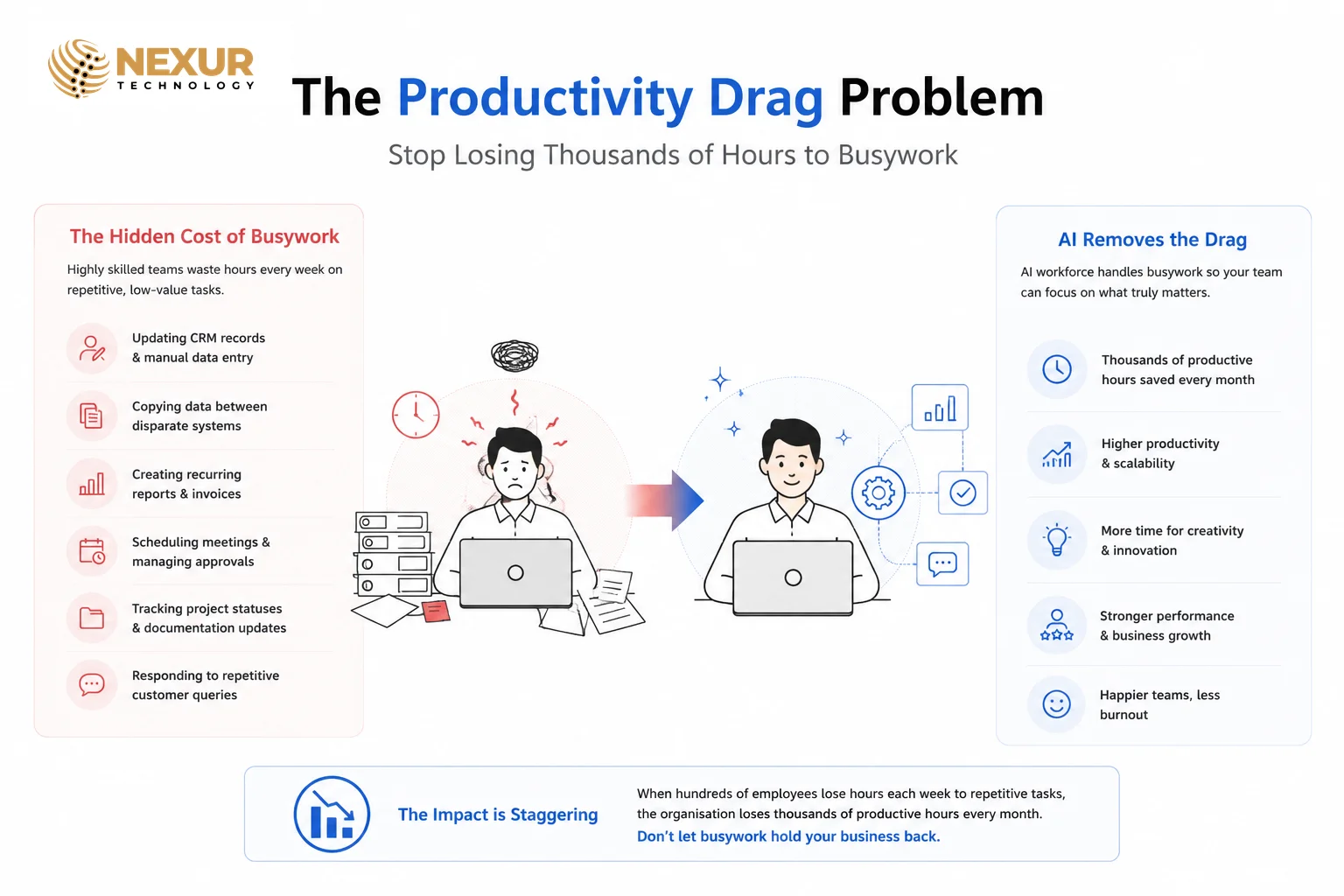
Across every sector, highly skilled employees are being drained by a productivity drag: the hidden cost of low-value, repetitive activities that hinder an organisation's ability to scale.
Traditional attempts to fix this through outsourcing or standardisation have largely failed because they were fundamentally limited by rigid procedures.
This drag is caused by an accumulation of busywork, such as:
- Updating CRM records and manual data entry
- Copying data between disparate systems
- Creating recurring reports and processing invoices
- Scheduling meetings and managing complex approval workflows
- Tracking project statuses and documentation updates
- Responding to repetitive customer queries
The cumulative impact is staggering.
When hundreds of employees lose hours each week to these tasks, the organisation loses thousands of productive hours every month, stifling the very creativity and innovation required for growth.
3. Why Old-School Automation Hit a Wall
For decades, we attempted to solve inefficiency through traditional automation and Robotic Process Automation, also known as RPA.
However, these methods eventually hit a wall because they operate on if-then logic. They require every step to be predefined. If a situation changes or context is required, the system fails and requires human intervention.
Modern AI changes this equation by moving beyond rules to understanding.
Traditional Automation vs. Modern AI
| Traditional Automation | Modern AI |
|---|---|
| Rule-based logic: operates solely on predefined, rigid procedures. | Natural language and context: interprets human language and understands situational nuances. |
| Human-dependent: requires manual intervention for any exception or change. | Self-evolving: identifies patterns, learns from interactions, and handles exceptions autonomously. |
| Rigid output: limited to repetitive, fixed-sequence tasks. | Dynamic action: analyses large datasets, recommends actions, and generates content. |
AI enables an entirely new operating model, allowing organisations to automate work that was previously considered un-automatable.
4. Your Digital Department: The AI Workforce in Action
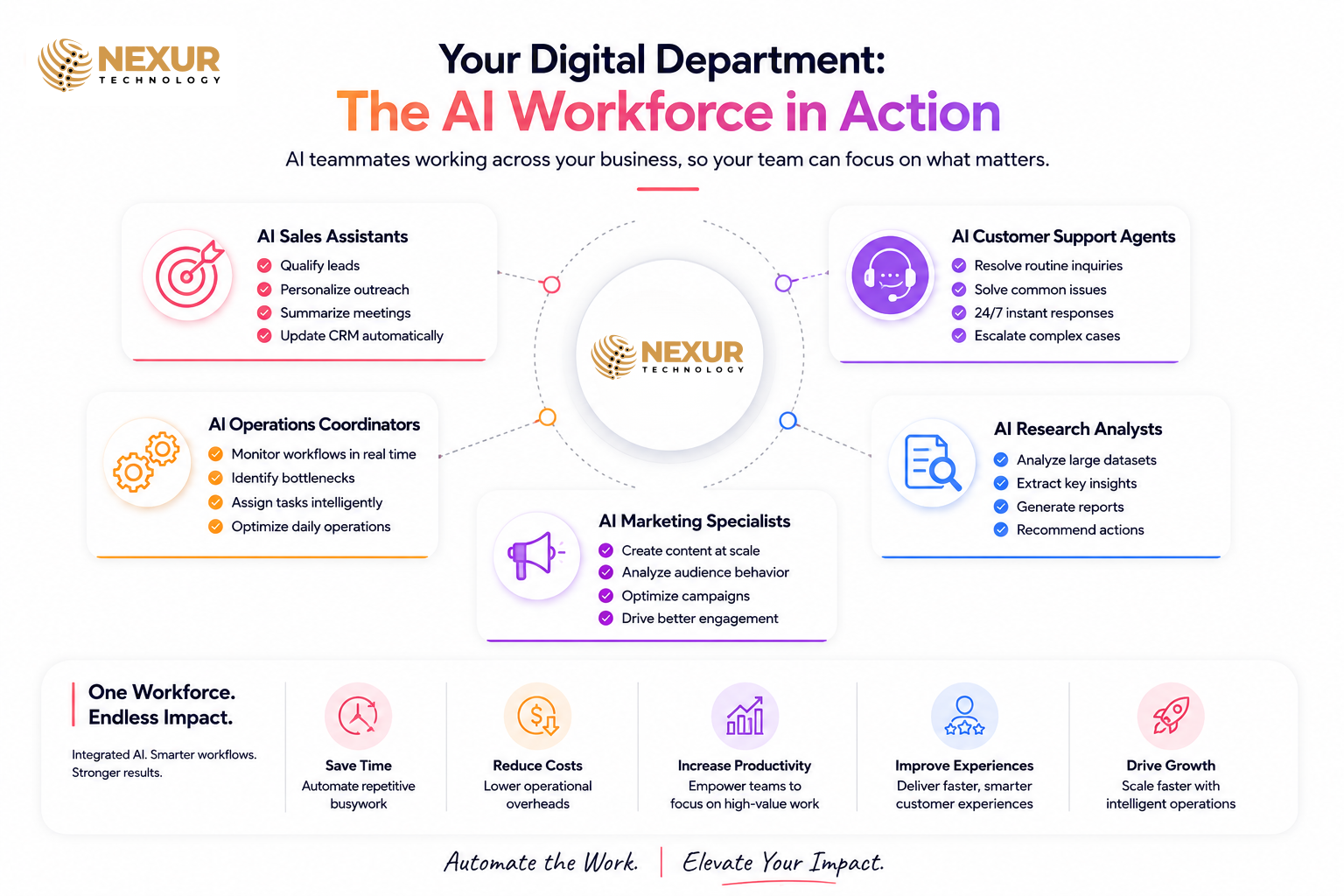
The AI workforce functions as a digital workforce layer embedded throughout your organisation.
Rather than existing in silos, these systems integrate across departments to handle the heavy lifting of operational work.
AI Customer Support Agents
AI customer support agents resolve routine inquiries and common issues autonomously, escalating only the most complex cases to human specialists.
AI Sales Assistants
AI sales assistants qualify leads, personalise outreach, summarise meetings, and ensure CRM systems are updated without human input.
AI Operations Coordinators
AI operations coordinators monitor live workflows, identify bottlenecks, and assign tasks to optimise daily efficiency.
AI Research Analysts
AI research analysts process vast datasets to generate actionable insights and reports at a speed no human team could match.
AI Marketing Specialists
AI marketing specialists manage content generation, audience analysis, and the continuous optimisation of multi-channel campaigns.
The most significant gains are realised when these roles are integrated, creating a seamless flow of intelligence across the entire business.
5. The Road to 2030: Why the Clock is Ticking
We are witnessing the convergence of four unstoppable trends:
- The exponential improvement of AI models
- The plummeting cost of implementation
- A growing comfort with AI in mission-critical roles
- Intensifying competitive pressure
By 2030, an AI workforce will be a foundational necessity.
Organisations that fail to adapt now face a performance gap that is not just widening. It is compounding.
This gap will eventually become an insurmountable barrier for laggards, who will struggle with:
- Significantly higher operating costs than automated competitors
- Reduced scalability and sluggish response times
- Decreased capacity for innovation and lower overall productivity
- Fragmented and weaker customer experiences
6. Industry Spotlights: Who is Leading the Way?
The transformation is already visible across diverse sectors.
Professional Services
Consulting and legal firms are revolutionising research, documentation, and client analysis.
Healthcare
AI is being specialised to assist in diagnostics, administrative workflows, and patient communication.
Retail and E-Commerce
Leading brands use AI for sophisticated demand forecasting, inventory management, and hyper-personalised recommendations.
Manufacturing
Predictive maintenance and supply chain optimisation are becoming increasingly AI-driven to eliminate downtime.
Software Development
Teams are utilising AI for automated coding assistance, testing, debugging, and rapid documentation.
7. How to Start Building Today
Building an AI workforce requires a strategic roadmap that begins with operational analysis, not technology selection.
Before asking which tool to buy, leaders must ask:
Where does our business lose time?
Use this checklist to identify high-friction processes ripe for transformation:
- Do we have repetitive manual data entry or data-copying tasks?
- Where are the internal communication and approval bottlenecks?
- Which reporting and documentation workflows are currently manual and recurring?
- Are our customer service teams handling the same routine questions daily?
- Is administrative overhead slowing down our sales and lead management?
8. The Human + AI Collaboration
The shift toward an AI workforce is not a race against the machine. It is a powerful collaboration. By offloading the busywork, organisations empower their people to focus on the high-value work that machines cannot replicate.
Human Strengths
- Strategic thinking and complex decision-making.
- Leadership, empathy, and emotional intelligence.
- Creativity and high-level relationship building.
AI Strengths
- Processing and analysing information at an immense scale.
- Maintaining absolute consistency in repetitive tasks.
- Rapid pattern recognition and the generation of instant insights.
9. Conclusion: The Future of Scaling
By 2030, the question will no longer be if a business uses AI, but how effectively it has integrated AI into its workforce strategy.
AI is no longer an optional luxury. It is a foundational capability that enables an organisation to operate with a level of efficiency and scalability that was previously unimaginable. The future of productivity belongs to those who act now.
By starting your transformation today, you position your business to thrive, leaving behind the era of busywork to embrace the era of exponential growth.