How Automation Audit Can Benefit Firms
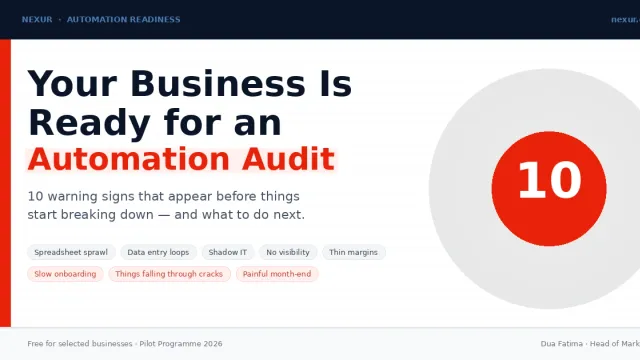
How a structured automation audit helps firms prioritise automation, reduce costs and improve efficiency.

As a business grows, small fixes start to pile up. What worked for a team of 10 often slows down a team of 25. Quick solutions turn into daily habits, and those habits slowly create hidden problems and extra costs. Most of the time, you don’t notice it until things start breaking or slowing down. By then, it’s harder to fix. One way to deal with this is by automating how you review your processes. But without a clear plan, even that feels confusing. So the real question is: where do you start?
What Is Automation Audit?
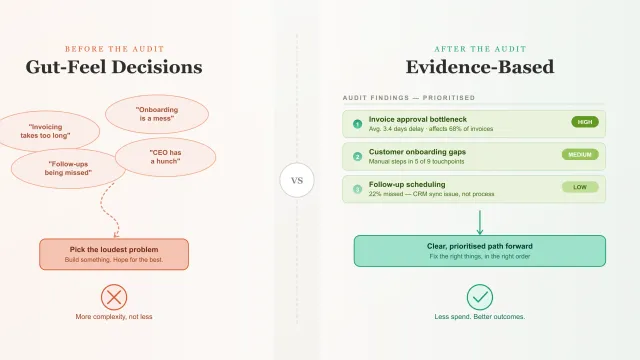
An automation audit is a structured review of how your business works to identify where automation can save time, reduce costs, and improve efficiency. Instead of jumping straight into tools, it looks at your processes, systems, and team to understand how work actually gets done. It highlights manual, repetitive, or inefficient tasks and uncovers gaps that may be slowing you down. The result is a clear, prioritised plan showing what to automate, what to fix first, and where you’ll get the most value, so you can make smarter, more informed decisions.
The trick: work that involves rules that are repetitive, or rules that can be automated things that need to be done, but don't require a human to make a decision are good things to automate. With a properly run audit and the right automation approach, it will not increase the workload of your employees.
Why is it a bigger issue now?
The current landscape of the automation market is getting more competitive day-by-day. Businesses have to produce more with the same or less, and their customers demand faster, higher quality, and less wastage. Agile companies aren't necessarily employing faster they're processing their operations and tasks smarter. They've identified where automation will really make a difference and have applied it appropriately.
What's lacking in the companies that are not doing as well is taking the time to plan and think.
The 4 Key Stages Where Automation Can Have an Impact
Data Collection And Consolidation
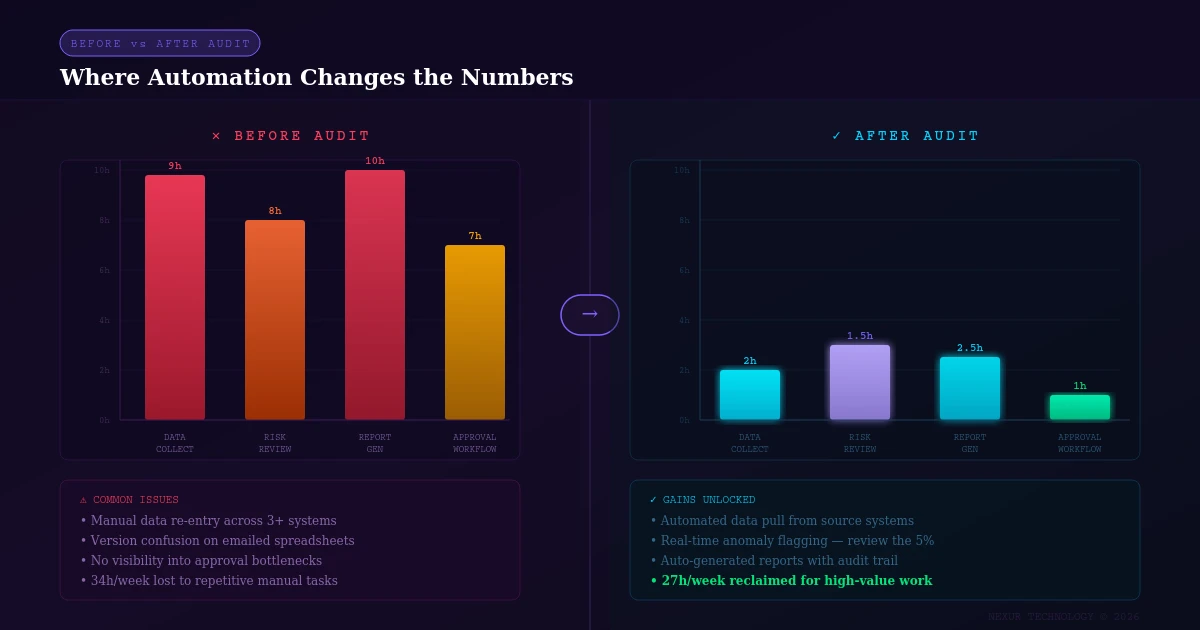
Individually extracting data from various sources (systems, clients, or staff) is a major cost driver. Automation tools can pull data directly from the source systems to aggregate data no need to key, re-key, and deal with version issues.
Identification of Anomalies And Risk
You do not need to review everything, but rather you need to review promptly. Get people to do the 5%, not the 95%.
Documentation And Reporting
Manually preparing workpapers and reports to clients is expensive. You can use processes to automatically create documents in the same format from existing data saving hours each time and reducing formatting errors.
Approval & Review Workflows
Emailing drafts between parties, losing track of document versions, and hunting for where errors are in a document are common issues that can be solved. A workflow with automated functions passes the proper documents to the proper people at the right time with an audit trail.
The Benefits Firms Really Care About
- Be More Productive With Existing Resources: By automating work, you can do more with the staff you have or the same work with less stress.
- Faster Turnarounds: Customers like faster turnaround on reports and fewer requests for change. It's more consistent with rules-driven processes.
- Clearer Visibility: You can observe practices and processes that are working and those that aren't (rather than infer).
- Reduced Risk: Centralised and version-controlled cloud-based documents with access controls are more secure and defensible than emailed spreadsheets.
Where Businesses Go Wrong
Automation only delivers these benefits if you automate the right things, and in the right way. Often companies work backwards: they buy tools before understanding their processes, which leads to poor results.
Companies that do this work first get an independent view of where they are: the process bottlenecks, revenue-impacting tasks, and the areas that should be automated. Only then do they acquire tools.
Where Nexur Comes In
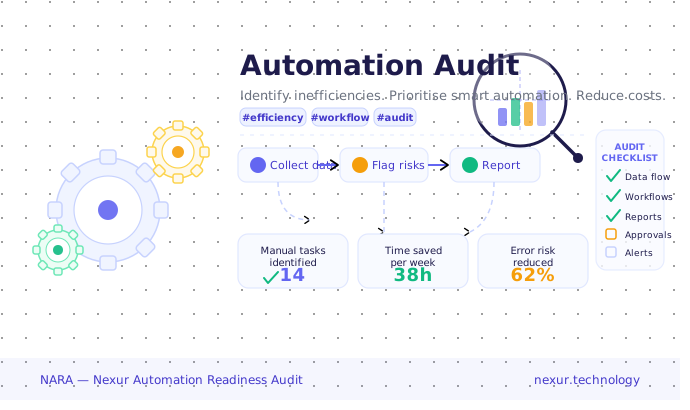
This is where our Nexur Automation Readiness Audit (NARA) helps.
We draw up a scientific picture of your business based on data we collect from your employees and validate it with our expert consultants. We then develop a strategy for you that won't be overwhelming, but will help prioritise that work. It's not a one-size-fits-all solution. We'll assess your business according to your industry and role. And it's affordable our pilot business pack will give selected companies the audit for free.
If the order of the day is to eliminate manual processes (and wondering where you are going to gain efficiencies in this process), we can help.
Apply for the pilot programme → Selected businesses are free. Limited places available.
Why Choose Nexur Technology?
We make life-changing software at Nexur Technology. We're making available our Automation Readiness Audit, with free trials for feedback. Apply here to find out if you're eligible. To book a demo and find out more about audit automation & how it can be implemented in your organisation → Book a demo / Contact our team

Featured
Turn Hidden Inefficiencies Into Measurable Gains
If your processes feel slow, fragmented, or overly manual, an automation audit helps you uncover exactly where time and cost are being lost. Get a structured view of what to fix first and how to unlock faster, more efficient operations.
Book a Demo / Start AuditKeywords